



“IN A GREAT CITY,” wrote Karan Mahajan in his award-winning ode to New Delhi, The Association of Small Bombs, “what happens in one part never perplexes the other parts.” In Delhi’s illustrious apartment complexes, by contrast, turbulence in one unit—extramarital affairs, domestic abuse, the acquisition of a new rock album—means turbulence for all.
This is especially true of the kind of family compound at the center of Mahajan’s third and most ambitious novel, a once grand, often colonial-era residence that, in the generations since Independence, has been subdivided into dozens of dwellings. It is in these close quarters, and against the fading memory of India’s freedom movement, that The Complex takes place.
Mahajan has always been a political writer. His maximalist family dramas, antic with black humor, are trained on the ills of contemporary society; were they trained on the bourgeoisie of nineteenth-century Germany instead of New Delhi, comparisons to Buddenbrooks would be obligatory. Mahajan’s own social criticism centers on the enduring problem of communal violence. His first novel, Family Planning, set in the aftermath of the Gujarat riots in 2002—whose events are an indelible stain on the BJP, the governing party since 2014—satirizes politicians more interested in stoking sectarianism and investing in vote banks than in implementing legislation. The protagonist, a minister of urban (not so much “family”) planning, deflects questions over his extraordinary number of offspring (thirteen!) with an ironic quip about India needing “more Hindus.” He then congratulates himself on his political acuity: “Luckily, he’d had the foresight to use Muslims as scapegoats. In this, he had become like all his colleagues in the party.”
The Association of Small Bombs, a finalist for the National Book Award, traced the unraveling of two families, one Hindu and one Muslim, whose sons are victims of a terrorist bombing at a Delhi market. Alongside its portrayal of profound grief, the novel’s multiple perspectives asked readers to sympathize with the feckless Kashmiri separatists responsible for the attack, as well as with the Hindus who subsequently seek revenge on their Muslim neighbors. It’s a darker book, and more ruthless about mining Mahajan’s other primary preoccupation, the vanities of Delhi’s cash-poor yet real-estate-rich bourgeois. After losing his two sons, the Hindu Mr. Khurana tells acquaintances that the boys were at the market to “pick up his watch” from a repairman, rather than the “old Onida color TV,” for “to admit to their high-flying friends that their children had not only died among the poor, but had been sent out on an errand that smacked of poverty—repairing an old TV that should have, by now, been replaced by one of those self-financing foreign brands—would have, in those tragic weeks that followed the bombing,” destroyed him and his wife for good.
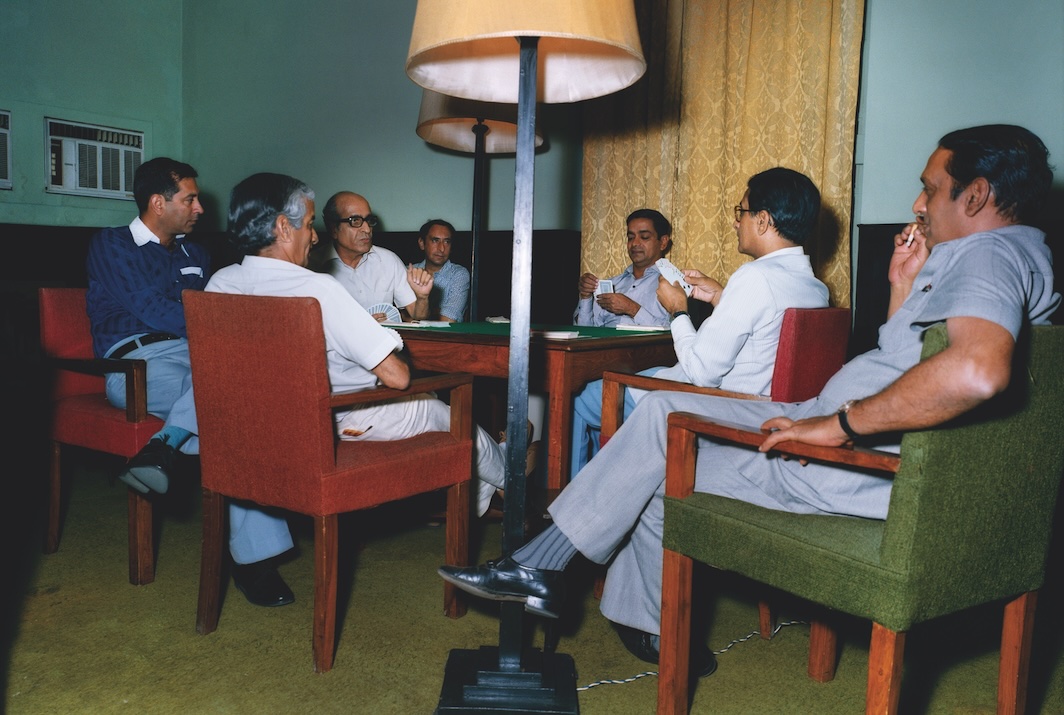
On its surface, The Complex is another family drama from Mahajan, roiling with the petty disputes and jealousies that plague any close-knit and cohabitating clan. Its greater scheme, however, is to invoke the psychological “complex” of a certain kind of middle- to upper-middle-class man who defected from the Congress—the party of Gandhi—to join the BJP. To capture the full arc of this transformation, Mahajan turns to the past.
IT’S THE 1980s in socialist India, nearly forty years after Independence, and the Chopra family complex and its squabbling inhabitants are “in decline.” SP Chopra, the freedom-fighting patriarch and banker on whom the family’s once sterling reputation is staked, is ten to twenty years dead; the purity of his contributions to the Independence movement, namely in the form of loans, is cast in doubt. Among those he leaves behind are his youngest son, Laxman, and two grandsons, Brij and Sachin. All of similar age, each is eager to uphold Chopra senior’s legacy, yet unsure how to channel more modest talents into pursuits of similar renown. In contrast to the glorious campaign of expelling the British, the lives of this latter generation are dominated by the encroachment of capitalism (the most successful of the trio, Sachin, invents the squeezable ketchup bottle), by the fading memory of colonialism, and by the accruing disappointments of socialist India under the once-dominant Congress Party, today the enfeebled foil to the ascendant BJP. At the novel’s start, Congress’s rapport has been tarnished in the wake of the Emergency (1975–77), when then prime minister Indira Gandhi, fearing an unprecedented loss of power, imposed authoritarian rule.
“They’re complexed,” Sachin says of the family to his wife, Gita, failing, in characteristic Chopra fashion, to include himself in the diagnosis. “The whole country is complexed thanks to Nehru’s socialist policies.”
Resisting the standards her Americanized husband is wont to apply, Gita responds, “We’re a young nation. We’re growing.”
That SP Chopra is Laxman’s father, rather than grandfather, places him one generation closer to the glory of his freedom-fighting forebears. (Sachin and Brij are technically Laxman’s nephews; their wives, Gita and Karishma, his nieces-in-law.) Accordingly, his own “complex” over living up to SP Chopra’s reputation is especially fraught. He is both the family whip, brokering backdoor deals between disgruntled kin within the compound, as well as its least employable member, better at dreaming up entrepreneurial schemes than at executing them. Without a job or career (he’s inherited his rooms in the complex as well as land in the ancestral village), he is, compared to his nephews, phenomenally ill-suited to contributing meaningfully to India’s modernizing economy, but uniquely gifted at negotiating the class ladder to secure opportunities for himself and—when convenient—the family. As Brij thinks, “That was the thing about having Laxman in their lives . . . though he created problems, he also solved them.” He is, in short, a born politician.
“I liked you first, I sent the first proposal from the family—” he exclaims to Gita, his nephew Sachin’s wife, negotiating special dispensation just before he rapes her in the opening chapters of the book.
THE NOVEL IS DIVIDED INTO TWO HALVES, with a short coda at the end. The first follows Gita and the consequences this shocking rape has on her marriage, her life with Sachin in the States, and her ability to call India “home.” Once a rising star at a New Delhi publishing house, Gita has since joined her husband, a graduate of Brooklyn Polytech and an industrial engineer, in Midland, Michigan, where he is hard at work at a plastic-packaging corporation. That they are unable to conceive becomes a private tragedy and an all-too-public matter back in the complex, where the family is constantly offering ayurvedic remedies and other unsolicited advice. (An elderly aunt even privately suggests that Laxman ought to try to impregnate Gita, as families did in “olden days,” only to be shocked when she discovers he might actually have attempted to do so.) The desire for a child becomes a quiet allegory for the second and third generations of independent India itself: “The reason we all need to have children,” one of Gita’s childhood friends tells her, “is that we stop obsessing about the past, about our parents. When you have kids, your love flows downward.”
Once a solace, Gita’s frequent trips home from Michigan are now a dreaded affair, inevitably leading her back to the Chopra complex and the man who raped her. Her sudden alienation from India is due to trauma, but also to adopting, like Sachin, the expat “complex” of the diaspora class she has only reluctantly joined. The rendering of her interiority emphasizes the latter: on her first journey back to Delhi after the assault, arriving “on a dry, warm, mid-March night, she felt like a stranger. Not because she wasn’t Indian; no, no, she was Indian down to her organs, but because, with a sadness, she could see India for what it was: shabby, poor, slow.”
There’s both a queasiness and, possibly, a tragic veracity to refusing to allow Gita’s thoughts to be dominated by sexual assault in these early chapters. A fuller expression of the emotional fallout would have no doubt swallowed up the entire book, as well as Gita herself—a danger of which she seems aware: “Gita would not talk about this incident for years: How could she?” The speed with which she feels she must bury the experience is nearly as upsetting as the crime and can only be interpreted as repression. Back home, she sublimates her anger and mortification by throwing herself into suburban assimilation, a new job, and an extramarital affair.
“I want to stop trying,” she says to an oblivious Sachin, swearing off the idea of children for good.
The second half of the novel shifts to Laxman, back in Delhi, who, quickly forgetting his assault of Gita (in his mind, it was never the crime she claims it to be), enters into a consensual affair with his other niece-in-law, the clever, beautiful, and uniquely subjugated Karishma, who lives with the physically abusive Brij and their two sons. (The affair finally ends when Laxman rapes her, too.) His will to sexually conquer his nephews’ wives seems related to his own “complex” of unrequited entitlement, which is to say to his father’s ubiquitous yet fading legacy. Noticing patriarch SP Chopra’s portrait at the Jeev Sangathan temple whose funds Laxman both manages and misappropriates, Karishma is struck by the fact that she hadn’t noticed the photograph sooner: “They lived in a world where that picture, like that of Mao in China, was hung on every wall. She had stopped seeing it.”
They say a story is only as good as its villain. Outside of Laxman’s despicable relationships with women, Mahajan’s portrayal of his antagonist as affable and above all naively boyish is the book’s major gamble and achievement; were it not for the rape in the opening pages, he might have stepped out of Thomas Mann’s The Magic Mountain as an aged, more corrupted Castorp, a man-child just as apolitical and as easily seduced by the Right as by the Left. What sets them apart—and what cements Laxman’s destiny as villain—is that his lack of ideological direction is due to vanity rather than cheerful, Castorpian naivete. “That’s only one part of the story,” he says at the aforementioned temple, when another worshipper alludes to far-right connections that would tarnish the Jeev Sangathan denomination and, by extension, SP Chopra himself, once a leader in the faith: “There were also many great freedom fighters in the Sangathan.”
There are always many sides to a story in Mahajan’s India, especially for an opportunist.
It is Laxman’s need for cash, rather than his political conviction, that eventually leads him “in a roundabout way” to politics, where he becomes a campaign strategist for the BJP. His ideological conversion, however, arrives all too effortlessly. In another conversation that echoes “the talking points of the Hindu right,” a BJP attaché named Kapoor easily convinces him that the massacre of Operation Blue Star—when Indira Gandhi set the Indian army on a group of separatist Sikhs holed up in the Golden Temple in Amritsar, the holiest place in Sikhism—was not the political and ethical disaster opponents portrayed it as, but in fact a rare reason to praise the Congress. “It’s important to show that we Hindus are capable of using force,” Kapoor explains, “that we won’t let this nation fall into bits and pieces.” “So there was some advantage!” Laxman says, “boyishly clasping Kapoor’s large hand.”
Only a few chapters later, he has become instrumental to organizing a yatra,an inflammatory cross-country pilgrimage to a series of the holiest sites in Hinduism, which leads inexorably to acts of communal violence.
Despite his newfound talent for leveraging ancient history toward right-wing ends, as a politician, Laxman’s “great discovery” is “the present,” which might be seized for his own pleasure and power. Both temporal fixations, the book suggests, run contrary to the idea of India itself: “This was the strange thing about ancient civilizations,” opines the narrator, “they were the ones most obsessed with the future and with children; this is why they had survived.” This “hidden” speaker is one of Karishma’s sons—and belongs to Mahajan’s own generation.
MAHAJAN HAS BEEN JUSTLY ACCLAIMED as an uninhibited stylist—an Indian electronics store in Midland gleams with its look of “imminent plunder”; a delicate hand is suspended over a dinner plate “as if it were a harmonium”—but compared to previous books, The Complex is more tender, less arch, toward the suffering it portrays. This is possibly because so much of that suffering is female, endured by characters with less agency than, say, Mr. Khurana of The Association of Small Bombs.
The best lines are often reserved for the Chopra wives, who quietly dominate the book. The embattled Karishma possesses a “brilliant opacity, teeth like individual shields.” Archana, collateral damage to her husband’s philandering, nervously issues “endless bulletins from her brain,” exclaiming of an American onion that comes wrapped in its own mesh suit: “Wow, what a fancy attitude this onion has!” Despite the affair, she and Karishma are strangely loyal to each other—each is Laxman’s victim in her own way—and Mahajan is frequently at his best when depicting their domestic victories and disappointments. He takes special care with Karishma, who lives out the novel’s most tragic arc. Consumed with guilt after renouncing her affair, she returns to motherhood with tender insecurity: “This was what her bond with Mohit was like. She played the straight man as he mocked her with his increasingly adult smirk. She faltered between being irritated and indulging him, unsure of herself.”
While BJP chauvinists like Laxman and Kapoor are easy to dismiss as obvious cankers on the nation, the novel’s female cast also gives voice to more nuanced views, hinting at other reasons why so many Indians may have recently sought an alternative to the Congress Party. Seated in a garish American living room in Detroit (the bungalow’s “wildly landscaped lawn” looks “teleported from the fifteenth century”), another repatriated housewife, Cindy, Gita’s only true Indian friend in America, spars with the visiting Archana over Indira Gandhi, often presented as an Indian feminist icon:
“And look at what wonderful things she did for India,” Cindy said sarcastically.
“Some of it was needed,” Archana said.
“I’m surprised to hear you say that—forcing sterilizations?” Cindy said. “Destroying slums? Throwing opposition members in jail?”
“You get a biased view from here,” Archana said.
“That’s what people always claim—don’t mind my saying—but maybe one closes one’s eyes when one is there.”
Karishma, meanwhile, who is from the poorest background of all the characters in the book, laments sluggish economic growth under Congress: “It’s a sad, poor country,” she says to Laxman during one of their trysts. “The farther you go from the cities, the worse it is. And it’s getting worse every year.” A pre-radicalized Laxman replies:
“We’ve only been independent for thirty-six years . . . Give it some time.”
“Till then, the poor will live like animals,” Karishma said. “And the Congress will continue to do nothing.”
For whom should the novel’s intelligent, moderate, and unfairly treated women, all hailing from lower-class backgrounds than their puffed-up Chopra spouses, vote?
There is no question as to where Mahajan’s own political sympathies lie: The Complex is damning of the Hindu nationalist impulse that gained traction in the ’80s and ’90s and culminated in Modi and the BJP’s victory in 2014. But to a Western Anglosphere that has so often presented Modi’s rule in facile comparisons to Trumpism, or in condescending terms as evidence of postcolonial dysfunction, it is new—even taboo—for a novel to present the long-term failures of the Congress Party alongside necessary condemnations of Hindu nationalism. (The West’s framing of contemporary Indian politics can be an enduring annoyance to Indians sensitive to the diasporic gaze: “You get a biased view from here,” as Archana says defensively.) The Complex cautions against indulging the corruptions of a left that can pave the way for national chauvinists. Americans, take note.
IF THE COMPLEX earns the reputation as one of the first great novels “about” Modi’s India, it will be deserved. The sole distraction from its many successes in this endeavor is the predominance of rape. That the book reserves its wisdom and its patience for Laxman’s victims—Gita, Archana, and Karishma—places additional pressure on the decision to open it with a sexual assault. The profoundly private, interior, and idiosyncratic experience of processing such a cataclysm, and which the reader expects, never quite arrives. Nor is the crime quite integrated into the novel’s historical-political arguments. Uncomfortably, if intentionally, The Complex is not a novel about rape, yet one whose plot could not work without it. A deus ex machina lurks in the wings.
This is probably due in part to the fact that, in the vein of Mann or Stendhal, The Complex also strives, in the most rewarding way, to be a book about everything: left and right, love and power, history and time—that is, the pull of future and past on a country demanding something better than what its politicians in New Delhi have so far delivered. SP Chopra was nothing if not a man of “contradictions”: “peasant, landowner, banker, freedom fighter, Hindu reformer, orthodox believer.” Mahajan’s Great Indian Novel makes room for all of these and more.
Jessi Jezewska Stevens is a novelist, reporter, and professor. She is the author of three books, most recently Ghost Pains, which was a finalist for the 2025 Story Prize.