


TAKE IT FROM ME—IT TAKES GUTS to commit serious analysis of the Kardashians to the page. In a decade-plus of working full-time as a critic, I have mercifully not received much hate mail, except in the wake of an essay I once published about Keeping Up with the Kardashians, which drove one man in particular to reach out on three different platforms simultaneously suggesting I “[redact] [my]self in the [redacted] to death.” There are numerous legitimate ethical dilemmas in play around Kim Kardashian and her kin, albeit not ones that might be solved by my taking this angry man’s advice: more than one member of the Kardashian family is a billionaire, and there are, of course, no “good” billionaires. Kim, as recently as 2025, has shilled for Tesla, in spite of Elon Musk’s close ties to Donald Trump; the family’s influence on the prevailing beauty standard has itselfbeen criticized as having racist undertones, with their having popularized features more typically associated with women of color, but crucially, only for those with lighter skin; in 2022, Kim wore a dress made for Marilyn Monroe to the Met Gala and ripped it with the sheer voluptuousness of her body, and if such a mistake was not technically a failure of ethics, it was certainly a spiritual affront.
I suspect, however, that none of these things were at issue for the man in my inbox, and that what he was reacting to was my critical engagement with what he perceived as an ultra-frivolous subject—a family of celebrity women who are often accused of being dumb, talentless, idle, undeservedly rich, and too female to be trusted. The idea that this small group of babes might be socially and fiscally rewarded for little else but their good looks, their charm, and their willingness to televise their lives is, for some, unbearable, and it cannot be denied that a huge part of their appeal is the low-stakes nature of their output. For that essay, I watched ten years’ worth of the show in a relatively short amount of time and found myself fully immersed in a high-def, beige-toned world of sororal bickering and anesthetizing luxury. On the whole, the experience was numbing but relaxing, like watching a tank full of beautiful, ethnically ambiguous angelfish with stellar business acumen go about their lives. Would I sit through all eighty or so hours of footage again? With respect, I would sooner [redact] myself in the [redacted].
To think about the Kardashians for too long in our current political and cultural moment—a time of fascism, genocide, and war—is to feel a little like Kim herself in a very famous scene from Keeping Up, fruitlessly searching for a lost diamond earring in the ocean as her sister Kourtney reminds her that “there’s people that are dying.” And yet: it is impossible to say that the Kardashians lack impact. Our circa-now ideal of desirable womanhood is built, at least in part, in their image, with so-called Instagram face—full lips, vulpine eyes, a certain overstuffed plushness—having arguably first originated with Kim’s features. That these features are by now largely inorganic is reflective of another major shift the Kardashians have prompted in the world, for good or ill: namely, the widespread popularization of dermatological enhancement and cosmetic surgery, making looking like a celebrity far easier than at any other time in history, and making a great many of our actual celebrities look more or less the same as each other. Keeping Up first aired on E! in 2007, and ran until 2021, after which the family switched to a new show, The Kardashians on Disney, which offered a new variation on Keeping Up’s original format in the same sense that the second image in a tricky Spot the Difference puzzle offers a new variation on the first. The players, too, are consistent: Kim, the most famous one; Kourtney, the “real” one; Khloe, the funny one; Kylie, the bodacious one; and Kendall, the model. (The last two sisters, the youngest, are technically Jenners, not Kardashians, but their unifying K-names and clearly secured places in the firmament of stardom make them as much a part of the Kardashian empire as their elders.) Presiding over them is Kris, a self-styled “momager” with antecedents in the too-eager, sometimes deranged stage parenting of classic Hollywood. If by 2026, the Kardashian “moment” has somewhat passed, the late 2000s and the span of the 2010s in toto belonged to this strange, glossy, matriarchal clan: an engineered vision of perfection who were not, as one might have expected from a nominally all-American family, girlish, blonde, and Aryan, but curvaceous, brunette, and part-Armenian, instead.
Post Keeping Up, Kim Kardashian has become ubiquitous, as if she were a very hot dictator whose portrait hung in every home in America. To say she is “famous for being famous,” as people often do, is not quite right—what she is famous for is being Kim Kardashian, and by all accounts it is a challenging profession. She maintains a thriving business empire, selling clothing and iPhone games and perfume and jewelry and many other products, but she also serves as her own most valuable export—one consigned into homes across the world via TV and magazines and social media coverage, and regularly reinvented with surgery and styling so that her older incarnations have a built-in obsolescence. “In my industry, beauty is a talent,” her now-disgraced ex-husband Kanye West said in 2013. “You know, ‘What is [Kim] talented at?’ She’s talented at being beautiful.” At this stage in her career, Kim herself is less a woman than an object—not only in the potentially controversial sense of having thoroughly embraced her own sexual objectification, but also in the sense that she has made the va-va-voom silhouette of her body and the ever-evolving planes of her face so familiar to us that we know her from her outline alone. Her form is as much of a brand as her name. (Proof, if proof were needed, of this striking omnipresence: in 2018, she released a perfume in a bottle shaped like her acephalous torso, the implication being that she was famous enough for us to recognize her even when she did not have a head.) She is a self-made woman, physically if not entirely financially—her father, in an ideal bit of celebrity lore, is the late Robert Kardashian, the lawyer who kept O. J. Simpson out of jail. Born and bred for fame, streamlined for consumption, and seemingly blessed with an innate understanding of the shifting demands of the market, Kim is one of the most significant visual icons of the still-young twenty-first century, as indelible and era-defining as an iPod, or a Cadillac, or a Warholian soup can.

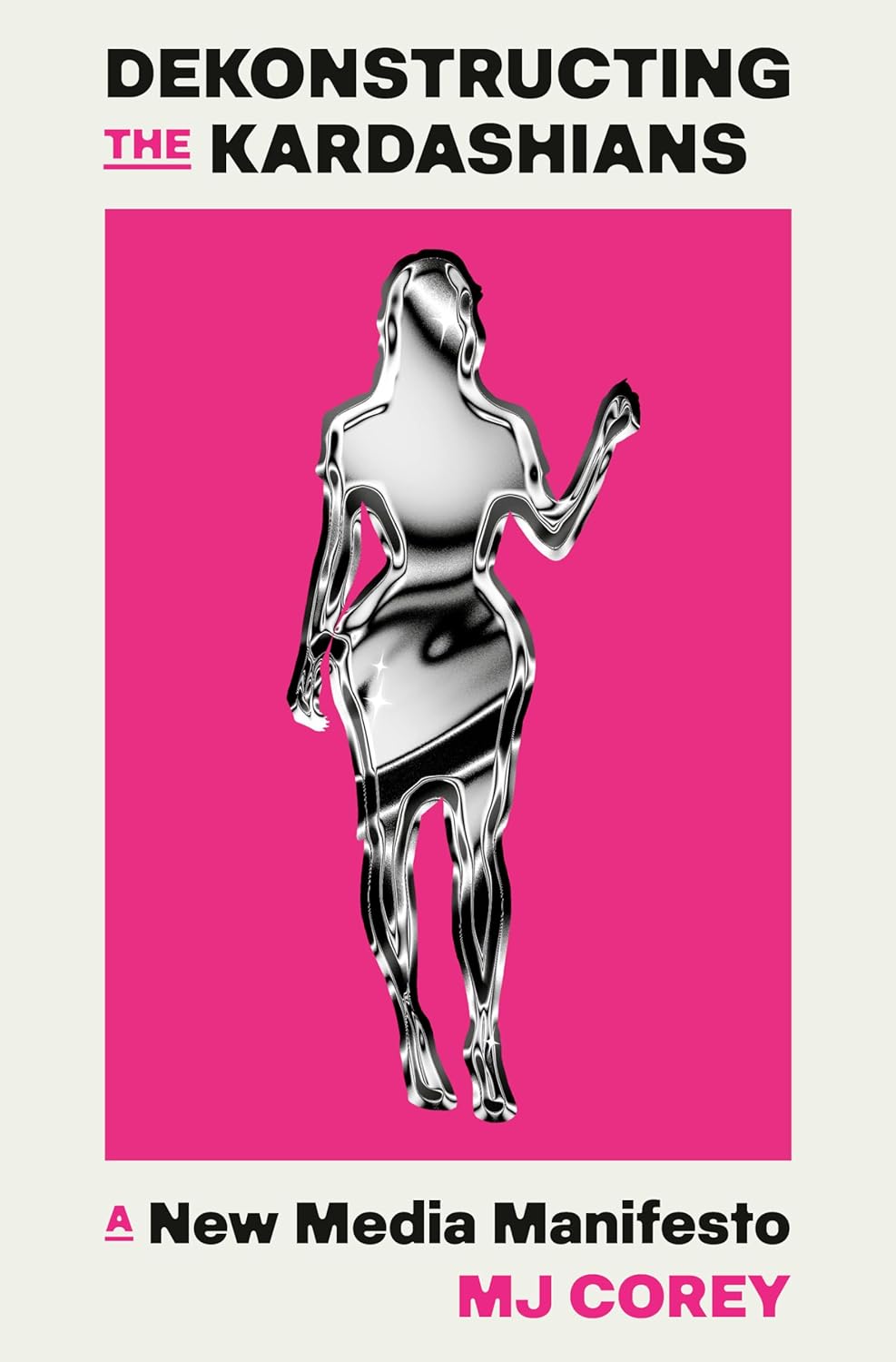
A few other icons that Kim Kardashian in some way resembles, according to the psychotherapist and writer M J Corey: a Coca-Cola bottle, Mickey Mouse, a WWE wrestler, the city of Las Vegas, Jackie Kennedy, Marilyn Monroe, Walt Disney, Elizabeth Taylor, and “an already unmasked [Rachel] Dolezal.” Corey’s fascination with Kim and her family began in 2018, when she first watched the aforementioned episode of Keeping Up with Kim’s lost earring, and found herself struck by an argument between Kim and her brother, Rob, about the former’s entitled and diva-like behavior. “Mom raised you better than that,” Rob insists, before landing a more serious blow: “Dad raised you better than that.” At this invocation of Kim’s late father, Corey notes in her new book Dekonstructing the Kardashians, Kim squirms a little, “in a way that feels incredibly ‘real’ within a hyper-produced episode that seemed to have been edited to achieve a near-perfect narrative structure.” This slippage, permitting a glimpse of apparent authenticity within a staged tableau—the specter of grief intruding on the splashy, organized fun of their televised vacation, like a single frame of snuff spliced into a soap opera—piqued Corey’s curiosity, and a new obsession was born. “When I mentioned to my sister, who was then a media studies major, the uncanny sensation this spectacle induced in me,” she continues, “she suggested that I read Jean Baudrillard, a French theorist who explores the way in which material reality as we know it is, more and more, becoming replaced by performance, advancing technologies, and commodity culture.” Arriving in 2018, Corey was admittedly somewhat late to the Kardashian party. She has certainly since made up for lost time: later that year, she established an Instagram account with the username @Kardashian_Kolloquium, which she describes as a “self-directed study of postmodernism,” applying “Jean Baudrillard’s and Michel Foucault’s theories to the [Kardashian] family.” Later still, keeping up with the times in true Kardashian style, she expanded to TikTok; now, she has turned the concept into a book, in which Kim, Kendall, Kylie, Khloe, Kris, and Kourtney abut Freud, Lacan, Debord, and Foucault. In other words, if you are the kind of person who is thrilled by the idea of reading theory in order to better understand Kim Kardashian, i.e., someone very much like myself, then rejoice: Dekonstructing the Kardashians is for you.
Predictably, Corey has been criticized in certain quarters for her merging of the lowest and loftiest forms of culture. Why, some wonder, would a perfectly sane psychotherapist be so intrigued by the Kardashian family? The answer is simple: because it is possible to argue, as Corey persuasively does, that they are physical manifestations of America’s psyche; flesh-and-blood representatives of a post-internet mindset that prizes aesthetics over meaning. “To me,” Corey writes, “the Kardashians are no different from other enduring national institutions such as Las Vegas, Disney, and the WWE, which have become what they are by way of spectacle, narrative, and self-mythologizing.” Later, she quotes Guy Debord, from his Society of the Spectacle: “All that once was directly lived has become mere representation.” If society post-Instagram cares more about representations of life than about living, then the same might be said of reality TV, a genre of entertainment that presents us with a falsified, souped-up version of “true” or “real” events, in an attempt to make actual life appear more interesting, dynamic, and glamorous. “The Kar[dashian]-Jenners, masters of contradiction, can be applied and deconstructed according to just about every aspect of American life,” Corey writes. Notice that per the very abridged list of comparisons that I included earlier, Corey sees Kim as being like Walt Disney and Mickey Mouse. She is, in other words, both manufacturer and product, and by cornering the market in this fashion, the Kardashian family has invented both a novel way of selling themselves and, by extension, a novel way of being. Kim Kardashian is “the train arriving at the station,” as Corey puts it, referencing the 1896 premiere of the Lumière brothers’ short Arrivée d’un Train en Gare de La Ciotat, “but she’s also actually busting through the screen.”
What was it that was said to have so frightened the audience when that locomotive rushed toward the screen, at the dawn of cinema? The shock of the new; the sensation that something which had previously been distant was suddenly too proximate. “It seems as though [the train] will plunge into the darkness in which you sit,” the Russian writer Maxim Gorky marveled at the time, “turning you into a ripped sack full of lacerated flesh and splintered bones.” The effect the Kardashians have had on their audience is somewhat less dramatic—still, for nearly twenty years, they have been plunging into darkened living rooms around the globe, and their impact has at times certainly felt like that of a runaway train. (Countless Insta-models, especially, have endured all manner of laceration on the operating table in pursuit of a Kardashianesque image.) Corey quotes a paper by Susan J. Douglas and Andrea McDonnell, which posits that we are drawn to the faces of the stars because, projected at the movies or pasted on billboards, the size of them mirrors the way we see our parents as infants. Kim Kardashian’s profile is all about scale: she is a “real” woman, but hotter, richer, more pneumatic, more successful, and—as proved by the virality of her crying face—more dramatically expressive than most. She has, in Corey’s estimation, “cracked the code: Embody every icon.” Per Dekonstructing the Kardashians, the collapsing of time brought about by the advent of the internet, so that past and present can be accessed simultaneously, allows a star like Kim to feel truly omnipresent, and to imitate Marilyn Monroe or Elizabeth Taylor while also presenting herself as an image of the future. Corey structures her book in three parts, like a cinematic or theatrical narrative split into acts: one about the Kardashians’ cultural progenitors; one about the earliest years of their fame, from 2007 to 2013; and one titled “Everywoman,” which covers 2013 to the present. This last title, referring to Kim, is a kind of double entendre. For all of her more recent efforts to portray herself as a family-centric businesswoman, a onetime-wife and a full-time mother, there is nothing regular about her. She is only an everywoman in the sense that she has, with her ever-shifting face and numerous professional endeavors, been every kind of woman one could possibly be.
Such slipperiness around her identity is a particular problem for the kind of misogynistic viewer who believes all women to be natural-born liars. “The fact that any onlooker of the Kardashian spectacle can tell it entails some mix of the real and the staged,” Corey suggests, “contributes to the family’s stigma for being duplicitous—an extension of a skill set that has cartoonishly characterized women throughout time.” Kim’s very womanhood has made it possible to use her as a pawn or a cipher, both in arguments in favor of female empowerment, and in arguments against it. She is Schrodinger’s Girlboss, at once making bank in a male-dominated world and ruthlessly upholding both sexual and financial inequality by monetizing everything, including her own flesh. The same double bind crops up in matters of race: as an Armenian American, Kim is sometimes read as white, and at other times as brown, or “exotic”; her popularization of traditionally non-white (and, crucially, surgically enhanced) physical features, meanwhile, is seen as blackfishing by her disparagers, and as a rejection of the blonde, blue-eyed, Aryan beauty standard by her champions. Corey, refreshingly, suggests in Dekonstructing the Kardashians that she prefers to avoid “embedding moral perspectives” in her coverage of the family. This decision allows her to sidestep a particularly frustrating trend in modern pop-cultural criticism: a mania for categorizing individuals, artworks, and media objects as wholly “good” or “bad,” “feminist” or “unfeminist,” when in fact the truth is usually more complex. The Kardashian family’s ubiquity means that they are likely to invite a wide range of opinions, and the very newness of their brand of celebrity means that it makes sense for their audience to not always be certain how they ought to respond. “Kim’s consent is part of the problem,” Corey writes. “It means she has a lust for fame.” Here she pinpoints another of the reasons the Kardashians are the targets of misogynistic ire: celebrity, like sex, is supposed to be something that beautiful women provide us without ever desiring or enjoying it themselves. A star who is desperate to be one is, in fame terms, a slut, abasing herself by being happy to be sold to the masses.
The current popularity of feminist reconsiderations of the unkind history of tabloid coverage of women is partly contingent on the idea that each of these figures has lived through an ordeal, and has either responded with appropriate misery and shame, or ascended to a place of unimpeachable feminist enlightenment. Kim is no sacrificial lamb, and if those who dislike her are waiting for her to complain about the toll fame has taken on her body, her soul, and her very sense of self, they may be waiting for a very long time. Even after she was robbed in her Paris hotel room in 2016, bound and gagged and held at gunpoint while the thieves stole her jewelry, she comported herself with a certain quiet dignity in front of the cameras, and made no attempt to dial down her glamour, even as certain commentators deployed the same fallacious arguments used to defend rapists—that she had been showing herself off, and that this willingness to flaunt her many gifts in a very public forum had made it inevitable someone would take something from her by force. At one point in Dekonstructing the Kardashians, Corey positions Kim Kardashian as a sex worker, of sorts: a woman whose empire is built, at least in part, on the release of a sex tape, but also on her body, and on a degree of exposure beyond that which is typically expected of a mainstream star. When Corey asked an adult entertainer with a minor role in Keeping Up with the Kardashians whether she thought of Kim as a “sex worker,” the response was an “unequivocal yes.” Sex workers, like celebrities, are often demonized for treating their job as a job rather than as an act of martyrdom, making the comparison all the more apt. Nobody, of course, needs as much money as Kim has, and any economic setup that permits an individual to amass such wealth is quite obviously fucked. Nevertheless, Corey’s resistance to moralizing helps her to make an even-handed, clear-eyed case for the Kardashians as a phenomenon that is interesting rather than “good.” The most generous possible reading is that Kim and her family have made the very best out of a rotten and imbalanced system. And why not? If a girl absolutely has to get [redacted] in the [redacted] in public, she might as well get paid.
Philippa Snow is a critic and essayist who lives in England. Her books include It’s Terrible the Things I Have to Do to Be Me: On Femininity and Fame (Virago, 2025), Trophy Lives: On the Celebrity as an Art Object (Mack, 2024), and Which as You Know Means Violence: On Self-Injury as Art and Entertainment (Repeater, 2023). Her forthcoming pamphlet about Sex and the City, Perfect Little Woman, will be published by Episodes in spring 2026.