


MY MOTHER INTRODUCED ME TO LANGSTON HUGHES the way I imagine many Black mothers have introduced Black sons to Langston Hughes for decades, if not a whole century: when I became a teenager, she made me read his poem “Mother to Son.” “Well, son, I’ll tell you: / Life for me ain’t been no crystal stair,” the poem begins. It’s immediately clear what the appeal is for Black mothers who want their sons to know the hardship of their lives but are too afraid, perhaps too protective, to let those Black sons know what it is they’ve experienced. The poem speaks for them. And even if those Black mothers never give those Black sons any further details, there, in the words of Langston Hughes, stands an enduring connection to the hardship of being a Black mother, a Black woman, trying to survive in America.
This is what keeps Hughes’s legacy going. From his early days publishing poems in the NAACP’s Crisis magazine, pioneering what came to be called “blues poetry,” he wrote about Black mothers, porters, washerwomen, sex workers, shoeshines, banjo players, gravediggers, mill workers, dancers, children—the entire spectrum of Black life that existed outside of the more “respectable” scenes of the emergent Black bourgeoisie of the 1920s. Crucially, he did so from their perspective and in their language. He gave poetic voice to people on the margins, but without making them all sound like tragic figures with nothing else going on but misery. “The poem, the picture, the song is only water drawn from the well of the people,” Hughes said in an address to the Alliance of Antifascist Intellectuals in Madrid, “and given back to them in a cup of beauty so that they may drink—and in drinking, understand themselves.”
There is plenty to drink with Hughes, if you engage fully with his work—which would be admirable, since it is not the norm. Because nearly sixty years after his death, Hughes has also become the kind of flattened artist who is recognized by name and barely understood as an artist. He may be read in an English class—I was assigned only two poems by Black writers in high school, both of them by Hughes—or you could see his verse on the wall at the DMV, which I did in the course of writing this. My high school teacher believed that Hughes’s “dream deferred” was the kind you have when you are asleep. In the grand American tradition, Hughes has been misinterpreted and reduced into something more palatable to the narrative of American exceptionalism.
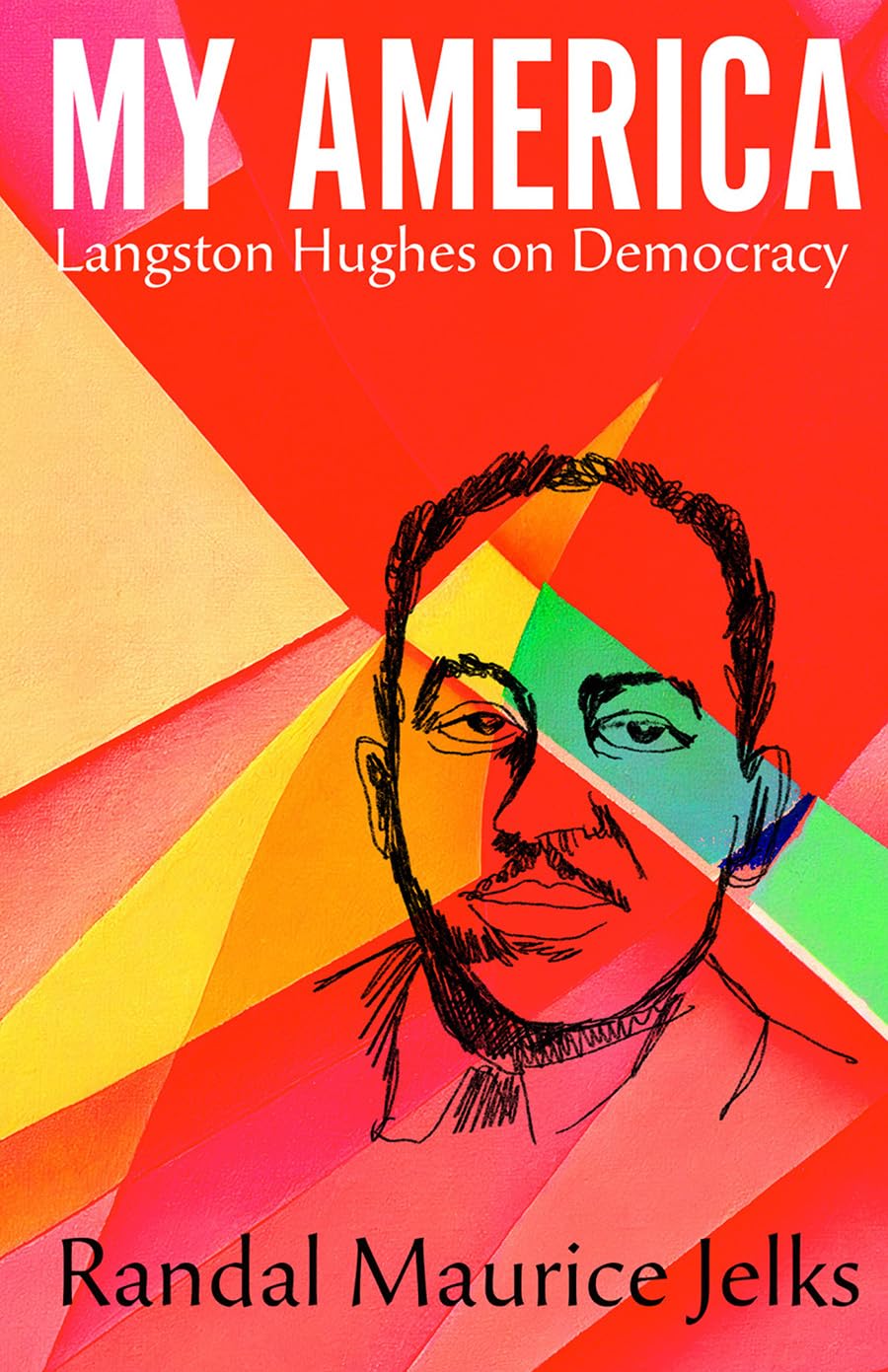
For his part, Randal Maurice Jelks, a professor of African American and African Diaspora Studies at Indiana University, looks to interrupt that narrative dilution with his new book, My America: Langston Hughes on Democracy. Jelks would like to show us the multifaceted Hughes: a poet, essayist, playwright, memoirist, novelist, journalist, and screenwriter committed to depicting Black life at its most honest and beautiful—neither confirming racist imaginations nor winning the praises of the “respectable” Black middle-class. A Hughes who was committed to ideas of a robust, actualized democracy, keenly aware of its principles and threats. And what better time than this to think capaciously about democracy, or the threat of fascism, or the role of artists in fighting for democracy and against fascism? While Jelks is after something real, he doesn’t quite find it. Still, I was happy to find a way back to Hughes. He has been preserved in the amber of Black American achievement, a tidy example of cultural excellence. But cracking that open and examining him from all sides forces a reckoning with questions about artistic and personal risk-taking, and the ways in which we are called to both challenge the systems of our oppression and survive them.
Jelks gives us an early biographical sketch of Hughes that lends insight into his roots, which formed the politics he would later be known for: “Langston’s personal affability; courteous, egalitarian, independent mind; and neighborly and soft-spoken demeanor were all traits that are valorized as Midwestern.” Hughes spent a good portion of his childhood in Kansas, the land that gave us John Brown and supported Eugene V. Debs’s presidential ambitions, giving Hughes access to abolitionist and socialist traditions. Before he had been introduced to Marx, Lenin, and the Bolshevik Revolution, Hughes’s sense of fairness was homegrown—American to the core—and became the cornerstone of his understanding of democracy; he latched on to Marx because his was a philosophy that reflected the values Hughes already held dear. His blues poetry was an expression of that commitment to democracy, expanding the notion of who counts, who is worthy, who deserves protection.
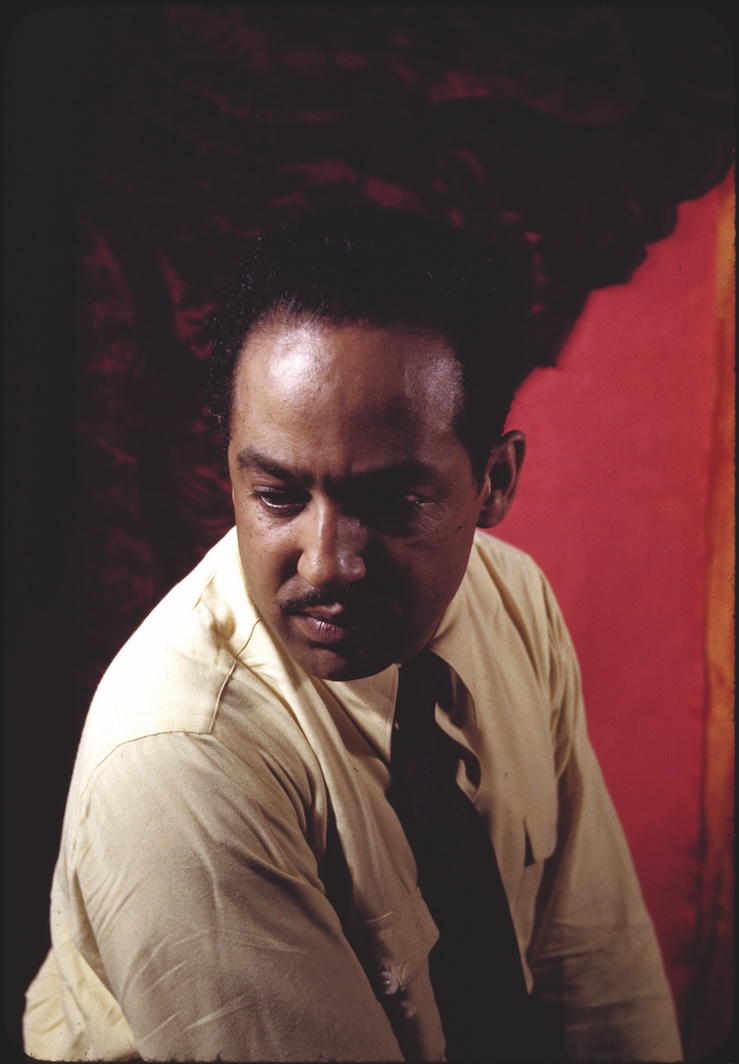
In the ’30s, Hughes made an explicitly Marxist turn. This is the version of Hughes that Jelks spends a good deal of time on, defending him from literary critics even as he admonishes him for not being critical enough of Stalin. Hughes traveled to the Soviet Union and became enthralled, like so many Black writers and intellectuals of the time, with a society in which his skin color no longer felt like a burden. The enemy had been identified as the capitalist, and to defeat the capitalist, the workers needed to be united, no matter their color, though Hughes never abandoned the idea of race as a salient factor in how Black Americans experience oppression.
He wrote poems then, too, but not the kind a respectable Black mother would make her Black son read, not if she wanted him to survive and succeed within the system as is. In the ’30s, he wrote angry, revolutionary poems like “One More ‘S’ in the U.S.A.,” which was published in the Communist newspaper The Daily Worker: “Put one more s in the U.S.A. / To make it Soviet. / One more s in the U.S.A. / Oh we’ll live to see it yet. / When the land belongs to the farmers / And the factories to the working men— / The U.S.A. when we take control / Will be the U.S.S.A. then.” In The Negro Worker, he published his most controversial and consequential poem, “Goodbye, Christ”: “Goodbye, / Christ Jesus Lord God Jehova, / Beat it on away from here now. / Make way for a new guy with no religion at all— / A real guy named / Marx Communist Lenin Peasant Stalin Worker ME —.” “Goodbye, Christ” was probably not intended for a wide audience but found one in 1940 (it was originally published in 1932), when it was reprinted without permission in The Saturday Evening Post. Jelks, who has a master’s degree in divinity and is ordained Presbyterian clergy, takes umbrage at Hughes’s dismissal of religion in favor of Marxism, while constantly coming back to Stalin’s atrocities and Hughes’s relative silence with respect to gulags. It’s a tired argument, and while Jelks defends Hughes’s idealism, he doesn’t give much consideration to the weight of his ideas—that capitalism has eaten away at the soul of Black America, and the only way through will be solidarity across racial and international lines to wrestle back what belongs to the workers.
But the boldness of Hughes’s radical period would not hold up to the fear and repression of the times. During the Red Scare, Hughes separated himself from the poem, writing it off as a youthful transgression. His 1943 essay “My America” begins with a reassurance: “This is my land, America. Naturally, I love it—it is home—and I am vitally concerned about its mores, its democracy, and its well-being. I try now to look at it with clear, unprejudiced eyes.” He distanced himself from Paul Robeson, another Black artist under attack for espousing Soviet sympathies. He entered a period of self-protection. While he never named names, he returned to his blues poetry, careful not to ever be associated with Communism or Communist sympathizers.
Of course, there is the added fear he must have felt as a queer Black man under the surveillance of a powerful government. Communism may have been the threat on every American’s mind at the time, but there were still means of talking your way out of such accusations. If he were to be labeled a “deviant,” there would be no coming back. But the poems from this era still exist, awaiting rediscovery and reinterpretation; in My America Jelks at least points us toward some of them, though he has little to say about their merits. Jelks admits to not being a literary critic, only a party interested in Hughes as a notable figure in American history and thus is not able to guide us through much of what we might find worthy of taking away from this period of Hughes’s work.
The poems vary in quality, to be sure, a lot of them flat-out bad. Hughes was responding to the needs of the times—the worldwide threat of fascism abroad, the denial of democracy at home—and saw his art as one component in fighting. There are always artists and critics who have seen this as antithetical to the making of art, who have believed art should be free of any moral or political dogma, and indeed that it is most effective when it eschews strict commitments to any agenda. It is a debate that has no end—except maybe the revolution that Langston Hughes sought to write into existence in the ’30s. Art may not make revolution (no one thing makes revolution), but it makes connections, between time and space, between histories, between mothers and sons. Which is all Hughes wanted us to feel, whether through the blues or Marxism—connected to one another. It is how we survive.
Mychal Denzel Smith is the author of The New York Times bestseller Invisible Man, Got the Whole World Watching (2016) and Stakes Is High: Life After the American Dream (2020; both Bold Type Books), winner of the Kirkus Prize for Nonfiction.