


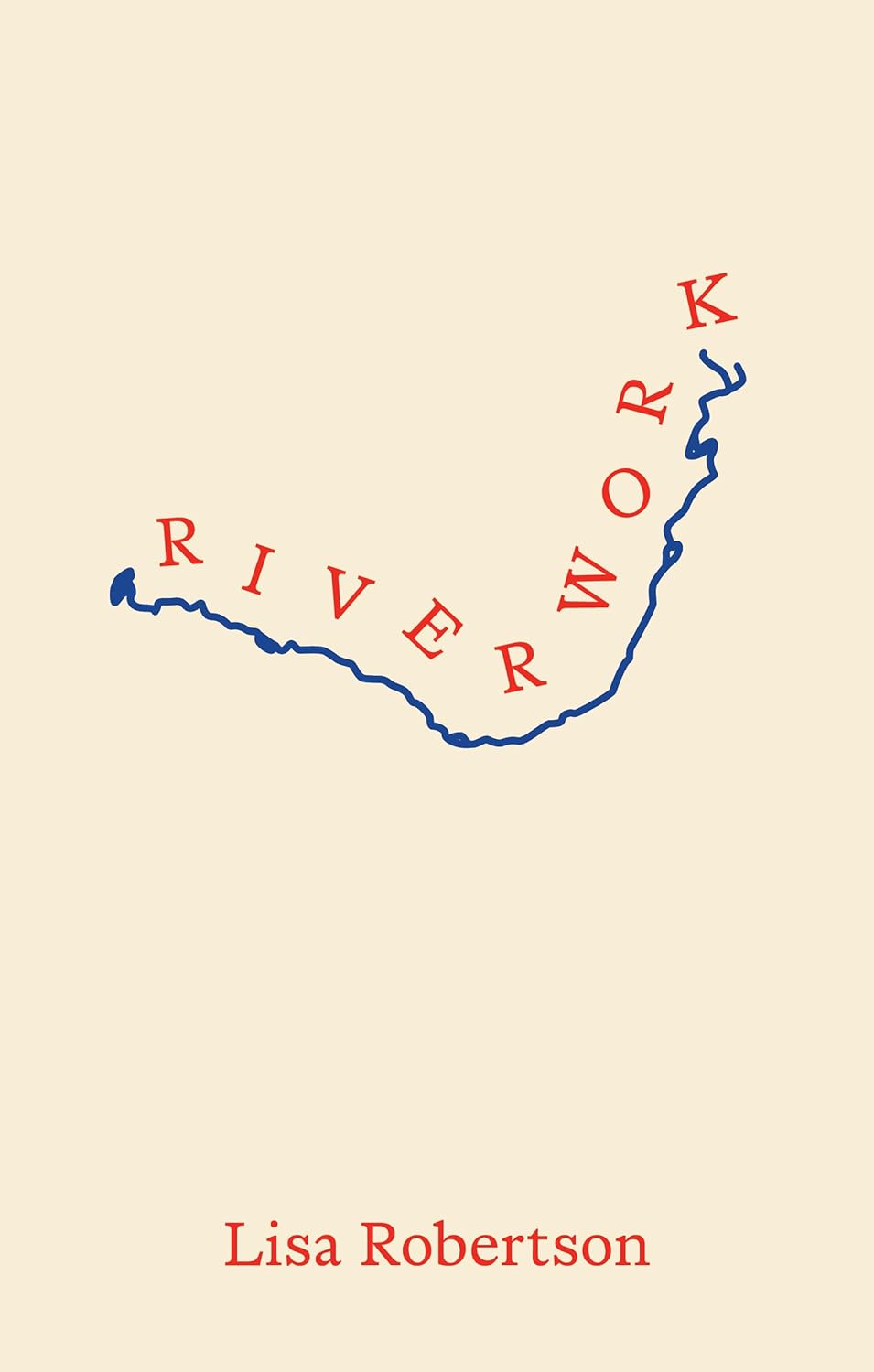
THE SECOND NOVEL is an abundantly documented enigma, but if you’re Lisa Robertson and your second novel is also your seventeenth(ish) book, it’s less an enigma than it is an invitation to begin again—and Robertson’s career has, for over three decades now, been dependably refashioned or reconstituted or reorganized by beginnings, all of them variant (of which the above triplet of synonyms provides an example). Her work is also pleated with fugues and repetition. “I needed a genre for the times that I go phantom,” begins XEclogue (1993),Robertson’s second book, and every book since has continued thinking toward the fabrication of genre and the description of desire. Those desires frequently include clothes, philosophy, theft, architecture, notebooks, sex, historical research, cheap hotel rooms. The sentence, always. And in Robertson’s hand, the sentence—much like a river, or ribbon, or raw-edged seam on silk—just won’t sit still. Its movement is deviant; its pronouns, mood-ringed and fluid.
Born in Toronto in 1961, Robertson has been publishing since the 1990s, almost exclusively with Canadian independent presses, beginning with the now-defunct, Vancouver-based Tsunami Editions and New Star Books, later working with Book*hug and, most enduringly, the Toronto-based publisher Coach House Books. Most of Robertson’s work consists of poetry collections, as well as a few books of essays, an anthology coedited and co-annotated with Matthew Stadler, and one annotated translation (her own) of a text by Simone Weil. There are also some chapbooks, a great many art catalogue contributions, and a smattering of one-off editions (hence the “ish”). Most recently, Robertson has turned her pen (pilfered, probably) toward the novel: “I steal all the pens, every pen I’ll ever use. I steal the paper leaf by leaf and I steal each word and also the spaces between the words, I take them. I’ll steal each slow minute I need to write this account.”
Robertson’s debut novel, The Baudelaire Fractal (2020), presents a narrator named Hazel Brown who awakes one morning (in a cheap hotel room) to a frankly bonkers, full-body realization of improbable authorship: she has written the complete works of Charles Baudelaire. Hazel is now a poet in her fifties and lives in the French countryside, evidently sharing a closet—not to mention a literary history and intellectual sensibility—with Robertson, who has herself lived in France for more than twenty years. From the perch of middle age, Hazel Brown rereads her old notebooks that contain the awkward thrusts, ambitious outfits, and janky syntax of young adulthood: “My task is to re-enter, by means of sentences, the course of my early apprenticeship.” The apprenticeship is that of sex, semiotics, and thrifted faux Thierry Mugler jackets. It was Paris; it was the ’80s.
Riverwork returns to many of Robertson’s core preoccupations: Paris, literary and feminist theory, menstrual stains, debt, the grammar of garments, Chateaubriand, and Gertrude Stein. Our narrator this time is Lucy Frost (until final revisions of Villette,this was the name Charlotte Brontë gave to Lucy Snowe). Lucy Frost is older, angrier: “I lie awake irritably in the density of the night and contemplate the fate of my body. . . . My head aches, my bones click, and I forget the facts. I’m sixty-three.”
Lucy is clearing space in philosophy for hags, with whom she identifies: “yes: I am a hag.” She is also a girl: “A girl reading philosophy is an anomaly . . . a hag in philosophy is an affront. I prefer both positions, girl and hag, anomaly and affront, in ever inappropriate combination.” Elsewhere, she calls herself a “failed poet and incendiary cleaner.” Also: an “insomniac, . . . a reader and a weeper, a scoffer and a scrawler, a cleaner”—I preserve her repetition on purpose—“a fibber, and a sipper, a doubter, a haunter of shame.” To this I add: a fastidious practitioner of lists, a theorist of surfaces, a maximalist of syntax, and a casualty of late capitalism. A series of stupid conglomerations and sadly recognizable gentrifications have yanked Lucy from the pursuit of poetry and the privilege of intellectual ambition:
The problem of money and not having it rhythmically arose. The kinds of modest freelance jobs that had for two centuries supported a bohemian life in writing—editing, proofreading, commercial writing for a popular press, reviewing, specialized magazine work, bookselling, even the itinerant teaching of writing—lost their setting by my middle age. The independent press, and next academia, was eviscerated by free-market dogma entirely malignant to the collective circulation of thought. . . . I gradually stopped striving for the creamy ideal of the poem.
What does she strive for now? The answer is language. Not the “creamy ideal of the poem,” sure, but maybe the word “cream”: “I . . . learned a new vocabulary for my striving.” In Riverwork,words are to be worn (picture a coat) and consumed (picture a cake)—like the word “moor”(“I learned the word moor and geography opened”) and the word “energy” (“I claim for myself the kitschy glamour of the word energy”). This is a novel that is also an inventory—the massive readerly pleasure of it residing in Robertson’s always surprising and elated handling of language: “Remembering the word metonymy.Remembering the word hegemonic. The word identificatory.The word interpellation.Remembering to say the words aloud. . . . You might think that I took the words in order to improve myself, or worse, to better my lot, but I took the words because they were there.” Words, after all, are free!
But Lucy still needs money. In these later years, she has become a cleaner by necessity, laboring invisibly and often painfully through Paris apartments belonging to the intellectual-academic class that once counted her among its members. She peruses others’ libraries and she steals time. “I have not transcended the glamour of thievery”—a classic Robertson confession. Now Lucy pursues theft from a different direction: “I still accept that whatever I desire is rightfully mine. But my desire has shifted. Now my kleptomania pertains to time, which I steal whenever possible. The thinking work that I do is slowly ruining my back. I therefore pause frequently to rest on paid time. I read my employers’ books.” She also brings her own rags, about which she is “quite particular.” She contributes “to the worldly circulation of rags, which is the ritual basis of all economies.” She devotes herself to dust and dust jackets. She goes phantom.
Lucy’s primary employer is a retired elderly woman who used to work at the Archives Nationales. She is known as the Archivist, which is dramatic, but so is her furniture. During Lucy’s first meeting at the Archivist’s apartment, she observes “a collection of ancient chairs [that] populates the periphery of the room, as if in mute audience. Their undulant forms correspond to my received idea of the eighteenth century.”
That’s the work, but where’s the River? The shape of the Bièvre curves across the cover of Riverwork and provides Robertson this hydraulic occasion for new sentences, themselves powered by a “plot” whose outline rhymes a little with a thriller: there is a lost river, a lost great-aunt, and the image of a woman paging through yellowed notebooks for traces of the dead. Until the beginning of the twentieth century, the Bièvre flowed through Paris and merged with the Seine in the fifth arrondissement, a site of trade, textile labor, and hunched-over laundresses. Now it is where Lucy will continue research first begun by her great-aunt Em, who disappeared during Lucy’s young adulthood, and has been presumed dead after her escape from a Toronto psychiatric hospital following a schizophrenia diagnosis. Lucy reframes the diagnosis as “political grief,” and understands that the inhumane medical treatments imposed upon her great-aunt were nothing less than “medically authorized techniques for the legal disposal of troublesome women.” During her lifetime, Lucy’s great-aunt studied Chateaubriand at the Sorbonne and researched the history of women’s labor along the banks of the Bièvre. Over the course of Riverwork,Lucy traces and untangles (or tangles anew) this research, reading and ruminating upon Em’s old notebooks, which she “had come into through theft or dream or inheritance, and what was the difference.”
The image of a woman reading under lamplight: Can you see it? The shape assumed by this reading body is, I think, the real plot—and chief delight—of Riverwork. Not the lost river, not the lost aunt, not even Lucy. Or: it’s all three, but each is an endless container in which Robertson may pour her thinking about reading, or writing about thinking, or reading about reading, always with a lushness, intelligence, and emotional generosity that is actually mind-blowing. The primary pleasure for a readerof Robertson is always in thinking about reading, and for Lucy, her readerly pleasure is “in pausing. I noted and ruffled every tiny texture as it arose, whether in my mental sensation of reading, or in my body as I cellularly assimilated the words . . . I was reading my body.” My reading heart turned soft as one of Lucy’s rags upon meeting this passage that begins as a description of duration and blooms into an ethics of love:
I tried to linger with my amorous incomprehension, to slow my attention so as to better savour the most intricate linguistic constructions and transitions as well as their attendant desiring states, which, love-like, kept shifting. With this hard-won slowing came the conviction that to truly savour a book, to savour love . . . one could not read slowly enough. The waking world must be replaced with love. The experience of duration became its own mystical pleasure. Did love ever arrive? Poetry arrived, and what is the difference.
Which I’m also calling an ethics of reading. Indeed, there is no difference.
Love also arrives through Kémi, another character/container, who is also employed by the Archivist as her private nurse. Kémi has emigrated to Paris from Dakar, Senegal, to pursue doctoral research in queer studies at Paris 8 University, and between Lucy and Kémi blooms a kinship—the poetic relation of two “accented people” to each other. When Lucy injures her ankle (“clumsiness was my calling,” she justifies), Kémi swoops in like a tall, dark, muscled fairy godmother in a motorcycle helmet. He comes to her apartment bearing gifts: a copious assortment of cheeses, meats, and, from Stohrer, Paris’s oldest pâtisserie, three pastries: “a religieuse, a merveilleuse, and a nun’s fart, in a gilt cardboard coffer resembling a rinky-dink handbag.” The name of the latter delicacy compels them to daydream the endorsement of the savviest thief in the history of literature: “we agreed that in spite of his preference for anti-theatrical theatre, Genet would approve of these perishable follies. He did love a nun, and he delighted in the pleasurable desecration of sanctity.”
After eating like queens, the pair begins turning over the question of late style, which has appeared in Robertson’s work before, maybe for the first time in Cinema of the Present (2014): “How else do you construct a pause in cognition? / . . . Grumblingly. / . . . With late style. / . . . It’s time for your late style.” Robertson’s former imperative now takes the shape of a dizzying plume of references, from the aging pores of Thelonious Monk or the eyelids of Saul Williams as seen in the films of Alain Gomis, to Chateaubriand’s Mémoires d’outre-tombe (here I leave the title in French because Lucy, over the course of the novel, is reading and indexing the Mémoires with the radical, necessary slowness of an adult language learner, “ten pages every morning over breakfast”) to Nicolas Poussin’s last painting, The Deluge, and Edward Said’s notion of late style, itself a response to Theodor Adorno’s analysis of Beethoven’s late works. Chantal Akerman’s 1975 film, Jeanne Dielman, 23, quai du Commerce, 1080 Bruxelles, comes into the frame not for the startling fact of Akerman’s age when she made the film (twenty-four, as not-late as it gets) but for its patience, its respect for the slow tempos of domesticity, its ethics of repetition (perhaps a third way of saying an ethics of love?). But Akerman’s youth likely informs Kémi’s advice to Lucy “not to confuse lateness with lastness. Time being knotted, he said, now tightly, now loosely, lateness and its style could erupt at any point in a life of making.” Lateness, death, duration, confusion, creation—all ignited by the image of Un Captif amoureux resting heavily on Lucy’s table. Puff pastries are dreams, or pockets, or trampolines, and everything is reading.
It has been a rule of my living to ignore—even hide from—AI and its concomitant discourse, so it surprised me, reading this book, how often my mind turned toward it (in rage, I hope that much is obvious). Riverwork is a hymn to slowness and close reading, unknowability, imperfection, wobbly human labor, false starts, and angry love; it is a scream against the increasingly omnipresent, automatically generated offers to synopsize, or synthesize, and therefore to strangle. It opts for excess. It is a mauve lipstick kiss blown to the book object, which is itself “a compressed synthesis of duration, a stylized representation of a lifetime or portion of life— . . . reduced to, say, an afternoon or a week or a month or a year of reading time, the reading further broken into haphazard parts due to the inevitable economic demands and social detours of life—working, eating, sleeping—this being form.”
I read Riverwork first in physical galley form, but a second time as a PDF because—as I’ve said before—Robertson’s sentences don’t sit still: there were various changes made between the galley and final versions, some related to footnotes (yes, there are footnotes), also to epigraphs (each of the twenty-nine chapters is afforded at least one epigraph), as well as many microscopically (but also tenderly, beautifully) altered syntactical choreographies. During my second reading, my Adobe Acrobat extension kept offering to “save” me time by summarizing the document. But I steal time by reading slowly and invisibly. It is impossible to summarize a Lisa Robertson sentence because the meaning of a Lisa Robertson sentence is made in the time it takes you to read it, hear it, feel it in your aching bones, stutter any one of its words. The meaning of a Lisa Robertson sentence is the sentence, and “the sentence is about the perception of living.” It is her phantom genre.
Claire Foster is a writer and literary translator from French. She also works as a bookseller at TYPE Books, an independent bookstore in Toronto. Her translation of Valérie Manteau’s novel, The Furrow, is forthcoming from Invisible Books.