


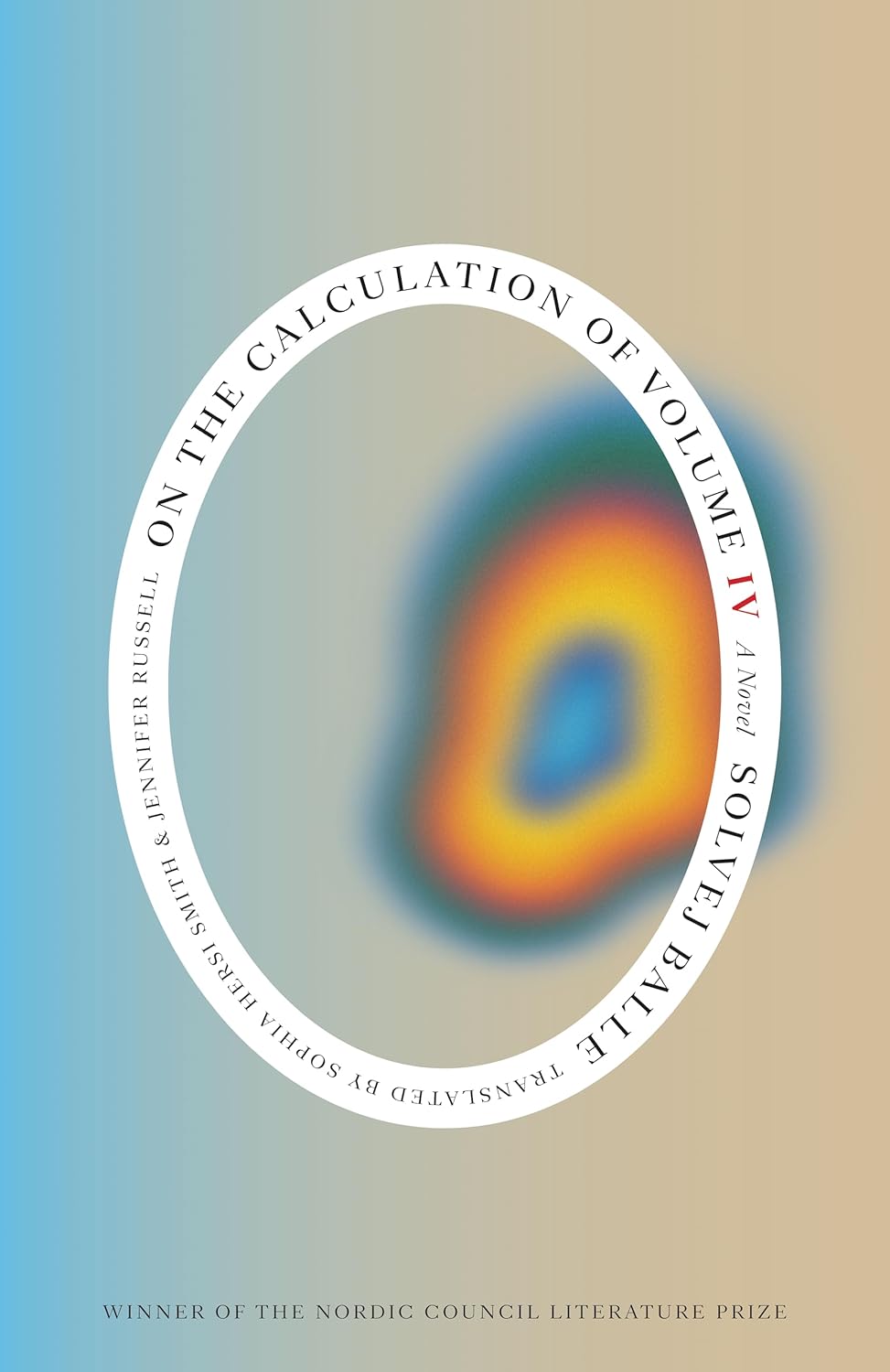
ON THE CALCULATION OF VOLUME is a series of seven novels by the Danish writer Solvej Balle that imagines a world in which one November day repeats indefinitely. Six volumes have so far been published in Denmark; in the United States, Volume IV is the newest to be available, in a translation by Sophia Hersi Smith and Jennifer Russell. The books are structured as the occasional journal of Tara Setler, a rare-books dealer. Volume I covered the first three hundred and sixty-six repetitions of the day; by the end of Volume IV, ten years have passed, and Tara is not any closer to understanding what is happening, or why. But asking “why” progressive time has broken would be asking the wrong question. Balle is not interested in the physics of space-time, but in a structure of feeling. The novels drift, skirting the existential terror inherent in their premise. In lieu of conflict, they offer the reader an anesthetized lyricism, an elegy for a world that, because it holds still, can at last be seen and heard and described—like an exhibition in a museum, or a body preserved in formaldehyde.
Each book is slim enough to read in a day. The journal form allows Balle to foreground Tara’s observations and meditations. “I can hear the water in the pipes and footsteps across the floor,” goes a typical entry. “I hear the fridge door bump against the corner of the counter, the rhythmic churning of the printer in the office upstairs.” Or: “I think of everything that is happening. Of all that must be. A duvet being lifted, a soft sound of fabric and feathers. A drawer being opened, wood sliding across wood.” Some entries linger on one interaction or event, but many more cover longer, vaguer periods that may be days or months long.
Tara is away on a business trip when November 18 begins repeating. For the first two volumes, she is the only person she knows who is aware of the time loop. What she experiences as another November 18 is, for everyone else, the first November 18. She learns how to manage: how to explain her presence in the bedroom to her husband, Thomas, who keeps waking up expecting to be alone; how to move through the house unseen by him, after she grows weary of explaining herself; how to responsibly shop, when the food she eats disappears forever from the grocery shelves, while what others eat is magically replenished overnight. Eventually she leaves Thomas and her home altogether, and finds unoccupied houses and apartments to stay in.
Thomas, friends in Paris, and eventually her parents receive her sympathetically. No one tries to have her committed, or worries unduly for her sanity, nor is there anything they can do to help. Tara’s body records time passing—a burn on her hand heals, and her hair and nails grow—but the people who aren’t aware of the repetition do not age. They wake up the same every day, always unaware that they have lived it before. In Volume II, Tara briefly considers that listening to others’ stories might somehow help her escape the situation, but she soon gives that up, and pursues travel, migrating north and south, seeking in different weather the solace of changing seasons. (She is advised where to go by a meteorologist—for some reason, she needs specialized data in order to find snow.) In Volume III, she meets more people who are aware of the repetition: Henry, Olga, and Rafe. Eventually they all move into an uninhabited mansion blessed with stores of provisions in the basement.
Over the course of Volume IV, dozens of others show up who are aware of the day’s repetition. Some move into the house, which functions like a commune or collective; others drop in and out, attending the regular meetings they hold. Balle spends many pages on the backstories of these new arrivals, usually focusing on where they were and what they were doing when time got scratched like an old vinyl record. While in previous volumes, Tara wondered in her journal about the right metaphor to use (is time a container, or a well?), in Volume IV such debates unfold in conversation. The group has long discussions about what language they should use to describe their situation, and whether they should track the days in weeks of seven, using the old words, or find new words to organize the calendar. The book’s climax is a conference the group organizes, featuring breakout sessions, like an NGO summit.
“What we needed was a word for the fallout: what had happened to us,” Tara writes in Volume IV. “Most of us felt it would be an overstatement to call it a catastrophe.” The idea that one could be suddenly separated from everyone known and loved, and not call it a catastrophe, may seem sociopathic. But underlying this insistence on the non-catastrophic is the notion that most people can get used to anything. There’s also a powerful, and perhaps comforting, fantasy at work—that unlike in the real world, where things have been getting worse every minute, a day that is always the same can’t get worse than it already is.
IN THE HANDS of another writer, Tara’s drive to retreat into observation and isolation would be symptomatic of anxiety, but Balle doesn’t invite us to see it in those terms. Tara never panics. She doesn’t seriously consider whether she has lost her mind. One of her main goals is not causing Thomas any worry. In the early times, they sit down together to try to figure out what’s happening: “We spent a few minutes debating various possible explanations: hallucinations or memory blips, misunderstandings or misinterpretations, temporal loops or parallel universes, but we could get none of these to make sense.” The prose style, in which events are catalogued rather than vividly presented in scene, makes it difficult to know how hard they really tried. But the meaning is clear: if a problem—let’s call it climate change—feels intractable, people lose interest in solving it.
There is passing acknowledgment, in Volume IV, that some people in the time loop are more distressed than others, but such moments feel abstract and dutiful. Balle is not interested in the emotional or psychological stakes, or even the social dynamics, of being stuck in time. In Volume III, one character has the idea to create a database of preventable harms, so that those aware of the time loop can spend their November 18 helping others. Though we later learn, in Volume IV, how he sneaks computer equipment out of his office to work on the database, we are never told how many or whether any harms have actually been prevented. One might want to find this morbidly absurd—the man who claims to want to help doing nothing but fiddling with his spreadsheet and calling for another meeting? But it doesn’t feel comic. Nor does it feel tragic. Nothing in On the Calculation of Volume occupies either register.
The problem here isn’t so much that the books are boring, though they certainly are; it’s that they don’t feel true—to life, to marriage, to any social relationships. As the days accrue, one notices more and more what is missing, what Balle has excluded from her vision. New characters pile up, but we get none of the tension that one typically finds in groups. Gentle debate unfolds, but no one argues or is nasty; no one attempts to manipulate or control the others. No potential cult figures emerge; no one is abusive or tries to hurt another person. Hundreds of people around the world have fallen into the time loop, and yet no killing sprees, massive robberies, or rapes are reported. No one tries to kill themselves. No one cracks a joke.
No one even seems to care that much about art. The group doesn’t watch movies or listen to music; no one retreats to their room to listen to the same sad pop song over and over. They don’t sing together or play instruments. No one reads aloud a poem or short story they wrote. No one talks about literature. At one point Henry mentions going to a museum and seeing a painting, but Tara doesn’t seem overly interested. She drifts around. She’s in her head a lot. Ultimately, her, the books’, interest is in logistics—in the status of disappearing and reappearing commodities, the mechanics of waste disposal. The question Balle raises, again and again, is how a responsible person or small group of people might live in a zero-growth world without draining resources from others. Whereas much dystopian fiction foregrounds the “crisis” aspect of climate crisis—floods, fires, scary disasters, all of which have obvious narrative appeal—Balle’s preoccupation is how to organize a sustainable lifestyle. As for curing one’s depression, the remedy she proposes is not having relationships with other people, but chopping wood alone.
THE POSITIVE CRITICAL RESPONSE to Balle has been led by those who admire how she, in the words of Dennis Zhou, writing in The New York Times Magazine, “rediscovers the texture of everyday life.” The word “texture” is revealing—Balle is most attuned not to the pleasures and difficulties of human connection but to the world of physical objects. (Perhaps it’s not surprising that Tara, a rare books dealer, would emphasize the thing-ness of a book rather than its textual meaning.) She devotes a great deal of narrative attention to how Tara and her peers learn to keep things they buy or acquire from disappearing, how they train or domesticate commodities. To bring something into the next (the same) day, it helps to sleep with it, and so people put groceries under their pillows, wear new clothes around the clock, etc.; someone sleeps in a car for a few weeks until the vehicle learns to stay in place when the day resets. Sewing old scraps of fabric together is effective. Dresses, skirts, and bedspreads made from previously worn garments have sticking power.
Like the characters in Groundhog Day and Edge of Tomorrow, Tara uses her time to pursue her interests. But unlike the characters in those movies, for whom learning skills (playing piano; killing) is bound up in a moral arc, Tara delves into solitary, dry study of the Roman Empire. Her obsession is not with the Romans themselves, but with their coins and ancient grains. In Henry, she finds someone who shares her passion for stuff. “What if it were actually the objects that held the power,” Henry muses in Volume III. “What if it were things that set the world in motion. A purple spur on a grain’s spike. A pebble in a shoe. . . . A phone that worked or stopped working. Rain or wind.” To believe that things rather than people “set the world in motion” is not to appreciate material history—it’s to fall prey to an ideological fallacy. Both Tara and Henry are hoarders, turning useful and necessary objects into uncanny fetishes and animistic totems. They are resigned to a world in which people cannot do or change anything—a world in which we work for things, rather than making things work for us.
Balle seems cognizant of the fact that a novel needs characters, lest it lose all readers. Henry is her most interesting creation, because, at least in Volume III, he is grappling with the pain of not seeing his son grow older, and with the fear that as he himself ages, he will become unrecognizable to the boy, and won’t be able to see him anymore. Time stopping has high stakes for him. He understands that time matters not only because it makes our lives finite, but because it is the medium through which we relate to others. Yet as the volumes progress, the people unknowingly repeating the pattern of the day become less real to those aware of the repetition. Even as the house Tara lives in fills up with others in the same situation—an enlightened elite, one might say—their relationships feel curiously thin. They are a chorus, or a bunch of representative positions, rather than people. Tara’s tasks and observations are “domestic” insofar as she is preoccupied with household matters, and she has withdrawn from anything like a public sphere. But her tasks do not really involve caring for others; when someone asks if she is the “mother” of the group, she immediately denies it. She is an observer—of the others, but also, of her own state of mind.
Tara writes of the effect of the time loop:
You’d think we would have gone mad, but instead something entirely different happened. An equilibrium of sorts set in. As if someone had brewed a healing potion and slipped it into our food, into our soups and casseroles. A sense that there’s no need to panic. Some sort of we’ll-be-alright tonic always close at hand. A feeling of calm. A resistance now gone.
For Tara, it feels “like a path had been cleared, snow shoveled aside.” A minor character, Adriano, suggests that the change to human nature, the disappearance of vice and greed, has occurred because no one is competing for jobs or to advance professionally, and because the “need to flaunt our status or wealth” can be satisfied by anyone; their credit cards work, and the bills will never come due. It’s a nice idea, if a little unearned. The book records no struggle to give up or change such deeply ingrained patterns. The most envy that we hear of is when one woman admires another woman’s yellow jacket, and then gets one herself.
The idea, I guess, is that crisis, while terrible, might yield a more cooperative, less unequal human society. Perhaps the contemporary novel was due for a rebuttal to countless apocalyptic narratives in which people amass power through social upheaval. Perhaps the point is that nothing short of a tear in the space-time continuum could break us of capitalism. Still—no one becomes a drug addict? There are no cults dedicated to sex? I can only conclude that it is the absence of recognizably human desires, as well as the lack of dread and fear, that explains some of the critical enthusiasm around Balle. Life would be simpler without conflict and desire.
Simpler, and quieter. No one in On the Calculation of Volume is ever on their phones. Perhaps that’s a trade-off worth making. Perhaps in order to cure us of our phones, time itself will have to break.
BY ALLOWING THE BURN on Tara’s hand to heal in Volume I, and her hair and fingernails to grow, Balle creates a problem for herself. But she doesn’t pay too much attention to this fact, until, eight years into the time loop, a doctor named Sonia raises the issue of “health and sickness” at a meeting at the group house.
Sonia had written health and sickness on her slip, and so we spoke about our bodies, and about how we treat them, about hospitals and preventative care. We discussed glasses, contact lenses, and eye tests, first aid classes, protein and vitamin D deficiencies. It’s not that we haven’t talked about these things before, but this time it came up because Sonia’s suggestion was chosen from the bag.
An irregularly updated journal is a useful literary device, because it allows Balle to address things that by all rights she should have dealt with hundreds of pages earlier while denying that she has neglected to do so. How is it, one might ask, that a burn can heal over subsequent mornings, but no one has gotten sick? How is that no tumors have been discovered, no bouts of pneumonia, that we have not even heard about the common cold? Is it really the case that no one needed a new eyeglass prescription? Why is no one suffering migraines from wearing the wrong lenses? We know that one character welcomes the repetition of time because it means that his father’s Parkinson’s disease will not progress. But what about people aware of the repetition who have illnesses? Did the time loop only ensnare the healthy? Are the people aware of the repetition somehow immortal or impervious to physical ailments? Are the fingernails and length of hair a misdirection or an exception to some other metaphysical rule—like how, when you’re dead, your nails and hair appear to grow, but it’s really that your skin is shrinking?
And what about the baby? Sonia and Peter get pregnant and then, we are told, “lose” the child. We don’t know what happened, and the characters don’t, either: the implication is that Sonia didn’t miscarry—she just woke up one morning and was not pregnant anymore. “No one could explain why it had happened. There was simply a small human being who never made it into the eighteenth of November.”
No law says that you can’t write a novel in which what happens to bodies is less important to people than what happens to Roman coins. But it has a curious effect. It torques the world, makes everyone in it seem a little alien or out of touch. Similarly, it’s strange that, given the utterly impossible event that has occurred, Tara doesn’t take an interest in religion or God. She makes no sustained attempt to theorize the eternal return of November 18 as eternity itself, with an obligation to make of it a heavenly one. No one contacts a priest or a rabbi or an imam to get their perspective, and no one—this might be the weirdest thing, considering the secular intellectual nature of the crowd—knocks on the office door of a theoretical physicist to get their facts straight about the metaverse. Instead, they debate metaphors.
Toward the end of Volume IV, Tara concludes that living apart from Thomas for years of November 18s has been merely a more extreme case of a universal human condition—that each of us is divided from others, living alone in our own minds. This depressing conclusion can’t possibly be taken seriously as a description of what life, or marriage, is really like; it pushes to the side all art, religion, politics, and social and collective experience. But it’s likely to be overturned in the next book, anyway. Balle has a habit of putting her most exciting events on the last page of the book, making them feel less like opportunities for her characters to think and act, and more like bait to keep the reader interested. The last page of Volume II introduced Henry. More new characters showed up on the last page of Volume III. In the last entry of Volume IV, a new development is announced: Thomas has called Tara. Thousands of days into his pattern, he did something unexpected—he entered the guest room, where he read some of her journal. Tara leaves the others and boards a train home to see him. Perhaps his return will inject some fresh energy into Volume V.
Christine Smallwood is the author of The Life of the Mind (Hogarth, 2021) and La Captive (Fireflies Press, 2024).