


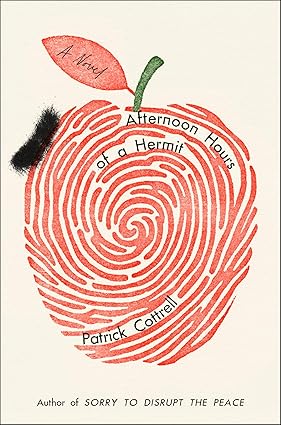
PATRICK COTTRELL’S FIRST BOOK, the novel Sorry to Disrupt the Peace, published in 2017, comes in a silvery gray dust jacket depicting a waterfall, in honor of the image the narrator brings to mind in moments of stress. The cover, designed by Sunra Thompson for McSweeney’s Press, looks lovely and peaceful at first glance, but when you pull away the jacket, you find a loud, neon-green hardcover with the disclaimer usually reserved for the copyright page printed all the way down the front in large capital letters:
THIS IS A WORK OF FICTION.
NAMES, CHARACTERS,
BUSINESSES, PLACES,
EVENTS, AND INCIDENTS
ARE EITHER THE PRODUCTS
OF THE AUTHOR’S
IMAGINATION OR USED IN A
FICTITIOUS MANNER. ANY
RESEMBLANCE TO ACTUAL
PERSONS, LIVING OR DEAD,
OR ACTUAL EVENTS IS
PURELY COINCIDENTAL.
Below, Cottrell has signed his name—not the name he uses today, but the one he went by in 2017, before he transitioned.
How to think of this opening move before the book is even open? The disclaimer is repurposed, turned into conceptual art. The line breaks give it the feel of a poem. The caps make it a scream. The scrawled signature transforms it into an oath, or perhaps a confession. The narrative promises this cover makes are complex—who is swearing and to what? It feels suspicious. Something here is not fiction, but what? Start reading the pages and you meet Helen Moran, thirty-two, a Korean adoptee, who learns that her brother, also a Korean adoptee, though not biologically related, has died by suicide, a gunshot to the head. She leaves her Manhattan apartment in a rush to return to her adoptive family’s home in a Milwaukee suburb in order to investigate the circumstances of his death.
It’s a brilliant book, part modernist detective story, part antihero quest, funny and sorrowful, with an unreliable narrator worthy of Nabokov (who is mentioned in the book). The questions raised on the cover about the protagonist are fleshed out through the novel, as she struggles to exude a peaceful exterior even as her interior is a knot of blame, deflection, grief, guilt, paranoia, and rage. Sorry builds into a meditation on identity and transnational adoption, capturing the deep alienation of being a Korean adoptee raised by white parents in a Midwest American suburb.
I picked up Cottrell’s recently published second novel, Afternoon Hours of a Hermit, and discovered, to my delight, that it is part two of the story of the Moran family. Five years have passed. Dan Moran, a Korean adoptee, is now a writer, the trans author of the autofictional novel Sorry to Disrupt the Peace. Dan, as you can guess, was formerly known as Helen, a name that Dan represents with an _______, which I will now do, too. The new novel opens a few days before the fifth-anniversary memorial for his brother Kevin’s death, when Dan decides to reopen the investigation. Once again, he leaves Brooklyn and boards a flight for Milwaukee. Two detective stories, each a quest that brings the (anti)hero back to the scene of the crime to turn over mundane objects that gleam with meaning and to ask questions of dull-seeming bystanders with secrets. As I read, the plots of the two books seemed so alike that I kept wondering, my god, did Cottrell write a version of the same book twice? Maybe so, and it is glorious.
AFTERNOON HOURS OPENS with Dan receiving in the mail a photo of his brother Kevin as a kid. Kevin is dressed as a detective in a trench coat, camera slung around his neck, large magnifying glass held to his eye. Dan turns the photo over in his hand. Who sent this? No return address on the envelope. It’s got to be a sign. But Dan wrapped up his investigation years ago. He wrote up his findings and published them, lightly disguised as fiction, in his first novel. He’s now an author and an adjunct professor, teacher of the “troubled youth” of Brooklyn. But even as he tries to brush the photo away from his mind, it whispers to him, “I am not done with you”—his brother calling from the grave. He phones his mother and—almost as if “she had forgotten whom she was talking to, Dan Moran, the metaphysical investigator, the one who takes their suffering, ruminates, and writes”—she begins to shower new devastating clues upon him. The night of Kevin’s death, she says, she sat at his bedside at the hospital, holding his hand. It was “small, shrunken and soft, . . . like a withered red apple.” The names of three women were written across his fingers in black marker, so the words looked like caterpillars. What were the names? She didn’t know. “Why was she telling me this only now?”
Dan is a solitary man. His only friends are the dead authors he reads, the troubled youth who write him messages like Yo Mr Moran I found out today my mom has brain cancer so I will need an extension on my workshop submission, and a therapist who asked him to stop leaving voicemails. His mentor is Thomas Bernhard, the Austrian writer who died in 1989, though in this book he is alive and well and still publishing. He was Dan’s professor in graduate school, but, Dan confesses, he hasn’t replied to Dan’s emails in years. Still, he ghosts through the book, turns up to offer a word now and then, as adviser and inspiration. The style of the book tells us Cottrell himself was likely influenced by the actual Thomas Bernhard. (Cottrell attended SAIC University for his MFA. Could Bernhard be modeled off of Jesse Ball?) It is Dan’s mentor who comes to mind the day he receives the photo: “Years ago when I told him during office hours I had solved the mystery of my brother’s suicide, he stared at a spot above my head and said a suicide is never over. Suicide is continuous, he warned me. Your brother’s suicide is a small river that flows into a big river. Suicide is a river that will never dry up.”
Dan is not a natural detective. He is barely holding his life together as it is. His return to the Milwaukee suburb of his childhood, land of “the whitest people on the planet,” is like heading into the heart of darkness. He feels as if he “were the sole survivor of an apocalyptic event,” and sleeps in a house that is “three thousand square feet of airless, sunless rooms more suitable for a morgue.” He has a series of awkward, even terrible interactions with his relatives, many of whom are baffled and dismayed by his transition and look at him like he is a dangerous stranger.
He sneaks around town, semi-disguised in aviator sunglasses and a stolen Playboy Magazine baseball cap, which fools no one. Despite his incompetence as a detective, clues are continuously forced upon him. There’s a late-night call from a woman asking for the “sister.” There’s an anonymous letter containing a “threatening smiley face” and a demand to come to a mysterious address. There’s a police officer who shows up in a patrol car, knocks on the door. “I was there,” she says, “when it happened.” There’s a Google review, an old yearbook, a brochure advertising a rundown apartment complex. The clues pile up. Dan reviews them every few pages. They drop down the page in lists, an ongoing drumbeat. “What else had I missed?” Any object could be a clue, even what’s in the cabinets, even what’s hung on the wall.
Cottrell’s two novels continue to echo each other. A tangle of similarities emerges. The plotlines follow the same patterns, beat by beat. The protagonists, _______ and Dan, have similar desolating conversations with family members, and both drive around in the same car Kevin shot himself in, the “deathmobile.” In one book _______ misses the funeral; in the other, Dan misses the memorial. They are both passive-aggressive with their parents, who seem numbingly unaware of their own aggression against their children. The writing styles have a similar cadence and sense of humor. The two books are siblings, purposefully so.
Dan, who calls Sorry to Disrupt “autofiction,” provides a list of ways he altered facts in the first novel. In the interest of setting the record straight, he reveals that in Sorry, he failed to mention his middle brother, Mattias, and he did not allude to his dysphoria. In this sense, the new novel becomes meta-autofiction—an autofiction that contains and reconfigures another autofiction. Just how closely Cottrell’s Moran books parallel his own experience, I don’t know, but Cottrell himself was born in Korea, adopted by an American family, and raised in Pittsburgh, Chicago, and Milwaukee with two younger brothers, Kevin and Daniel, who were also born in Korea by different mothers and adopted. Kevin Cottrell died unexpectedly in 2013 at age twenty-six. How much of these books is “true”? The reader can’t help but wonder, raising a magnifying glass, pulling on a trench coat. Dan becomes both a sleuth and the subject of our own sleuthing. _______ does, too. And Cottrell. And the reader. Many investigations, many protagonists, many clues.
IF SORRY EXPLORES THE TRAUMA of transnational adoption, Afternoon Hours adds the story of gender transition. Dan’s deadname, which was all over the first book, is now replaced with _______, and this blank is chilling. You feel his alienation from his family and from everyone he knew as a young person. The tone is set the moment he sets foot in the house and is mistaken for “an Asian male intruder.” He eavesdrops on his family in the kitchen. “I swore I heard someone in my childhood home refer to me as a semi-demon.” Throughout the book, he staggers under a barrage of microaggressions. Half the time he isn’t sure if he heard right or if he is imagining things, his mind playing tricks that reveal old family wounds and insecurities. He is haunted in his childhood home by a “sister,” who turns up in photos on the wall and in the mouths of people around him. There’s pain all over the pages. “It hadn’t occurred to me that they might be afraid of me,” he thinks. He imagines even his dead brother would struggle to accept him. Say Kevin just opened the door and saw Dan. “And how would I explain myself and who I had turned into?” Dan’s transition is relatively new, his protective mental equipment not fully in place. He remains stoic in the face of this onslaught, but you can feel him swallowing microaggressions, each one erasing a bit of what was so hard for him to become—himself.
The themes of transition and transnational adoption run together as Dan is continuously mistaken for one of his brothers—by strangers, relations, his former employer, a cop, his brothers’ old friends, even the only other Asian in the neighborhood. Does he really look that much like his brothers? Or, to people in a place with so few Asians, do all Asians look alike? In an eerie moment, Dan himself seems confused. He looks in a mall dressing-room mirror and observes, “Over a year on testosterone and I had somehow transformed into a combination of my two brothers.”
Much like Sorry’s dust jacket, Afternoon Hours is a book about layers of identity, of fictions, of writing. The prose is full of repetitions, echoes, callbacks, creating its own vocabulary and symbols, its own system of meaning. A number of phrases are repeated across the pages—“withered red apple,” “constellation of women,” “observation post,” “three-ring binder,” “the eye of inquiry”—and their meanings deepen and transform over the course of the story. The phrases work as talismans, holy words, curses, chants. The technique is reminiscent of Thomas Bernhard, who also used repeating italicized phrases to similar effect. The repetitions mirror Sorry, too, which has its own system of repeating phrases, some shared between the two books—“troubled youth,” “existential turtleneck”—pulling the books even closer together.
The novel is also, of course, about writing. And about writing about writing, and even about writing about writing about writing. Writing saved Dan’s life and continues to. “Instead of stepping off a stool, a chair, a bridge, I would sit next to Thomas Bernhard during his office hours, as he looked over my pages and immediately threw them into the trash. Or he would point to a sentence and say, This is a good one, write more of these.” Dan insists on his identity as a writer to his family, the reader, strangers, and himself. “The most significant difference” between himself and Kevin “is I’m still here and he isn’t. I am writing and he is dead.”
AFTERNOON HOURS and Sorry have similar plotlines, but somewhere in the new novel the tone diverges from its predecessor’s. Kevin begins to come alive midway through the second book in a way he didn’t in the first. In Sorry, he stayed a ghost, perhaps because ______ wasn’t ready to see him. In Afternoon Hours, Kevin arrives on the page. Details about him accumulate and pieces of who he was fall into place in flickers of memory, “the stockiness of his body in his light blue polo shirt . . . his thin hair limp against his skull,” his fondness for the number 666, his “vivid, fantastic dreams of excavating jeweled caverns, flying over lunar surfaces and deserts and gorges, polar expeditions,” “the sight of his black Honda Accord pulling out of the driveway to go somewhere, but where?” The revelations create a momentum. We’ve been starved of Kevin. We are ready to know him. Dan recalls Kevin helping him move into the college dorm and we hear Kevin’s voice, so rare in either book. He “told me my dorm looked like a place a person goes to die. And I laughed with him.” The reader feels a jolt at imagining the two siblings laughing together about one of their deaths. Dan meets a friend of Kevin’s and hears for the first time stories he knew nothing about. A group trip to Las Vegas, a photo—evidence—of Kevin and his friends on the highway. “I was astonished to see my youngest brother smiling.” Until now Dan has been so absorbed in his grief and protective ownership of his brother’s memory that it has barely occurred to him that his brother had friends. The prose style shifts into long passages of contemplation, as Dan tries to understand his brother. I read these late pages breathless. In Sorry we were given a flimsy excuse for the suicide, a reason that didn’t seem accurate. In Afternoon Hours we don’t get a better “reason,” but the question of a reason falls away, and in its place rises Kevin, as friend, brother.
Despite himself, Dan finds significant answers, many more than he did five years before. We are left with a new way to understand Kevin, one that turns much of what we believed on its head. We get answers about Dan, too, about his origins, before he flew across the ocean, bundled in a baby blanket, to the apocalyptic Midwest. The new book relentlessly reconfigures the first book, adding new perspective and meaning. Even the terrible parents receive some grace: Thomas Bernhard ghosts in and observes, “Your parents are not that bad. They seem simple but normal.” We nod in agreement. We saw all along their suffering.
And our own investigation? What do we conclude? Did Cottrell write the same book twice? The craziest thing is that in some ways, he did. It is shocking, even to him.
Why, why, why? Who did I think I was, to go over this story from years before, to rehash it, to tell it again, that same old suicide story, to bring it back to life? I thought of the authors who did that, the ones who wrote the same story over and over instead of using their imagination and radically reinventing themselves with each book, they chose to tell the same story, orbiting, stalking, obsessing, drawing closer and closer to their wound and their desire for it, picking at their scabs; writers who did this were probably the least defensible.
I’m not doing this because I want to, I said, but because I don’t have a choice.
In truth, most writers write the same book over and over. Beckett, Kafka, Proust, hordes of others, likely all of Dan’s favorites. Writers may shift the plotline, relocate the setting, throw confetti in the air to distract. But once a writer has found their subject, the question they will carry into the grave with them, it is a gift if they offer it to us. Dan asks: Five years down the road, who am I in relation to this suicide? Just as you can never step in the same river twice, suicide will forever be shifting. As Moran’s mentor, Thomas Bernhard, says, “A suicide is never over.” This may be true of all history and is why we need to retell it, every generation.
A final question. If a suicide is never over, will there be a Moran trilogy? I hope so. Dan uncovered more in this book, but there are still missing pieces. (I’m looking at you, Cousin Fran and Sofia. And what is on that billboard?) Another Moran investigation is due. But Cottrell is his own writer, and I doubt he is going to take audience suggestions.
I RETURN TO THE COVER of Sorry. _______’s exterior bore so little resemblance to who she was; she had to cover herself with a disclaimer and a waterfall of calm. Dan reflects on his “lifelong sense that he was an alien beamed down from some dark planet who inhabited not only the wrong body but also the wrong world.” I can imagine Cottrell looking at his first book, that disclaimer stamped across the front, the wrong name signed below. Was he really sorry to disrupt the peace? The title is funny and carries a tinge of hurt and accusation but also of determination. I can imagine him post-transition wanting to reopen the investigation, without erasing the last one. Afternoon Hours is the work of an older, wiser Cottrell with more self-knowledge and empathy. If Sorry is about grief, Afternoon Hours is about authenticity, about Dan figuring out how to go forward as a man, be himself, while still honoring his childhood self, whom Kevin knew and loved. And the message on the cover of Afternoon Hours is clear: the triumph of a beautiful ripe apple. The apple holds multitudes of meanings. The teacher. Urbanity and the vibrant city Dan escaped to. It also summons Fiona Apple, the most important musician of _______’s life, and the songs that connect Dan and _______. Notably, the apple is not withered. Fresh from a tree, a leaf still attached to its stem, this apple is bigger than life, takes up the entire cover, is ready for a delicious bite.
Deb Olin Unferth’s new novel, Earth 7, will be published by Graywolf in June.