


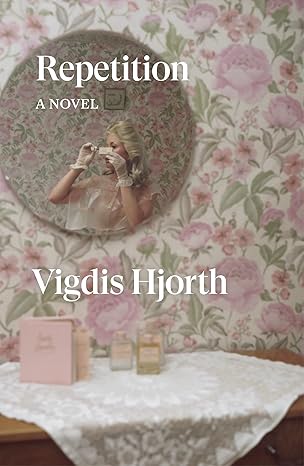
THERE IS SUCH A GLUT of unhinged female narrators in contemporary fiction that a recognizable microgenre is emerging around these often self-infantilized madwomen. My Year of Rest and Relaxation and its many imitators treat the instability and anhedonia of women as a source of self-deprecating comedy and little else. However enfeebled they have been made by their childhoods, their lovesickness, or their inability to cope with the social role they have been slotted into, Vigdis Hjorth’s protagonists face their problems—existential, psychological, or material—as adult women with a plausible mix of agency and unrestraint. Today, that is an exceptional quality.
Repetition is the latest of Hjorth’s novels to be translated from Norwegian, joining A House in Norway, Will and Testament, Long Live the Post Horn!, Is Mother Dead, and If Only. By now, Hjorth’s English-language audience will have come to expect certain recurring aspects of her books. On the line level, there is a powerful effect produced by the recycling of entire sentences, not only within a single narrative but across her body of work. It never becomes monotonous, as recurrence is itself a theme. In her essay “On Translating Vigdis Hjorth,” Charlotte Barslund aptly describes Hjorth’s novels as all “centered around a female narrator, a western everywoman.” Picture a well-off Norwegian woman artist—a weaver, a playwright, a painter. She is lonely for reasons she can and cannot control. Her lover is a nondescript man kept at arm’s length, or in the case of If Only a depraved (and married) writer who drags her into the most sordid affair imaginable. Either way, her relationship with this vaguely drawn man is a source of ambivalence or pain. Contact with her parents has become untenable due to devastating childhood events that are first brought up in an oblique way, then spelled out with brutal clarity. She is experiencing a crisis of meaning that she spends most of her mental energies trying to solve, neglecting in the process her children, her day-to-day life. She drinks a great deal. She is at turns naive, ironic, obsessive, enraged, and despondent, but there is an undercurrent of moral seriousness in her insistence that, even though she is in distress, she has some freedom to choose how she will live and she intends to exercise that autonomy.
We come to understand literary characters by the choices they make, or fail to make. Volition is the most important element of a story, of a life. In an interview, Hjorth recalls reading Kierkegaard while taking a flight during a personal breakdown, on the brink of a divorce. Both Hjorth’s Long Live the Post Horn! and Repetition borrow their titles from Kierkegaard, and through his work she has come to understand that “being an ordinary human being is an enormous task,” which is to be taken up with “complete sincerity and utmost responsibility.” This insight permeates Hjorth’s novels. One understands, through her characters’ ruminations, that these women are struggling to face the challenge of being alive.
Hjorth’s novel Will and Testament, longlisted for the National Book Award in 2019, was met with controversy in her native country. Its autobiographical content sparked debates about the ethics of writing from real life, or virkelighetslitteratur, as it is referred to in Norwegian. Hjorth’s depiction of a father raping his young daughter—which the author says is drawn from her own experience—was particularly inflammatory, and led not only to her mother threatening legal action against a stage adaptation of the novel but also to her younger sister writing an autofictional counternarrative, published with a title that translates to Free Will. Hjorth characterized her sibling’s response as a “revenge novel.” This real-life backlash mirrors the sense of embattlement and ostracization felt by Will and Testament’s narrator, Bergljot. Bergljot’s parents allot her and her brother Bård a meager inheritance—punishing the sexually abused child and her sympathetic brother—and privilege their two other daughters, who refuse to believe Bergljot’s claims that she was assaulted by her father. The gesture functions exactly as intended and reinforces the loyalties and divisions among the children. This inheritance dispute forces Bergljot to revisit her father’s transgression, not because she believes she can convince her relatives that the abuse actually occurred, but to enable herself to go on living in spite of the knowledge that consensus is not possible and that the truth will be denied. Considering the prospect of her estranged family organizing her funeral in the event of her death, Bergljot says: “I lost my birth family twenty-three years ago. It was my choice. . . . I was scared of dying, for my family to take over and thus lose my true self in death.” To ensure that she will not be misrepresented by her surviving relatives, she makes arrangements for two friends to organize her burial. Realizing that reconciliation remains unavailable, the character insists on allegiance to herself and to an honest account, not only in life but also in death.
Sexual violence courses through Hjorth’s oeuvre. Bergljot concludes, “It was part of me, it pervaded even the slightest emotion in me.” Who is more choiceless than a child sexually violated by a parent, then subjected to the repetition of the near-unanimous narrative that denies said violation? Bergjlot exercises her will even when she would have every justification for surrendering and giving into despair. Though there is real pathos in her insistence, Will and Testament is not a sentimental book. It oscillates between pensive repression and irrepressible, wild outbursts, but, like all of Hjorth’s novels, it concludes with an understated portrait of a woman who has acquired vital, hard-won wisdom unattainable to the family she has disavowed. The compelling suggestion is not that a person can change others through her tenacity, but that she may be able to reconfigure a self that she can live with. Hjorth’s characters are not saints. In Will and Testament the narrator frequently drinks to excess. In psychoanalysis, she wonders why intoxication leads her to sleep with unsuitable men and later downs a bottle of wine to “strengthen [her] resolve” before writing a letter to her estranged relatives. Hjorth treats her narrator’s drinking matter-of-factly. The women at the center of her novels do not spend their days in periods of intense self-reflection or contemplation of sobriety. When their drunkenness and melancholy give way to lucidity, they are forced into painful confrontations with reality. They do not shy away or retreat into fantasy. They act. They rarely behave in ways that accord with social norms around propriety. Candor and self-directedness, rather than uprightness, are their only forms of triumph.
I do not mean to suggest that these books are entirely life-affirming. Hjorth’s characters flirt with various means of escapism in the form of sex, substances, and suicidal rumination. “Anyone can work out that life is ultimately a losing game,” says Ellinor, the anhedonic PR consultant who narrates Long Live the Post Horn! after taking on a campaign to oppose a directive that will privatize Norway’s postal service. Privatization would not only worsen wages and conditions for postal workers but also lower the quality and reliability of the nation’s mail system. None of this means very much to Ellinor at first, and she is too preoccupied with grief and feelings of purposelessness to appreciate the stakes of the union’s efforts. She is reeling from the suicide of her colleague, Dag. The hilarious, and tragic, note he leaves behind before killing himself is characteristic of Hjorth’s morbid humor:
Hi Rolf,
I’ve had enough, am taking my boat and going away indefinitely, might return to Norway, though not to Kraft-Kom, I’m giving up the PR business for good, never should have got into it in the first place, tell that spineless bitch we’re in business with that I think everything she writes is shit, I’ve deleted everything on the computer so it’s ready for the next poor sucker.
Dag
The flippant tone, and the rage he expresses toward Ellinor, conceal the anguish that has proven fatal for Dag.
Anguish expressed as flippancy and rage is emblematic of the mood in America today, and as I reread this book, I could not help but think of my own generation. Daniel Kolitz’s Harper’s essay on gooning—Gen-Z’s novel, subcultural form of hours-long masturbation marathons to niche online pornography—is disturbing and illuminating because it documents a cohort of young men who are willing to forfeit real-life sexuality in favor of hours spent jerking off into the void. Gooning is the reverse side of the predicament of “trad” young women who have chosen to live by the slogan “I’m just a girl,” affecting childlike mannerisms and celebrating regressive gender norms to shield themselves from the daunting prospect of growing up. These twinned modes of shirking responsibility and avoiding attachments based on equality—obsessive masturbation for men and self-infantilization for women—suggest that many young people today simply do not see genuine contact with the outside world and their own selves as a worthwhile endeavor. These two cultural trends seem to reduce life to its most degraded, rote, and disempowered state. Why go outside? Why love another person? Why live at all?
AFTER HIS FUNERAL, Ellinor asks with real curiosity, “Why not emulate Dag?” A woman in despair, she begins to consider taking her own life as a viable option. She qualifies her question: “Why keep on going until I can’t, why rush about with no goal or purpose, sated, tired, fed up with everything and yet still hungry, good for nothing, subjected to an existence I don’t understand?” Later in the novel, after finding meaning through common cause with the postal workers, Ellinor listens to a rousing speech given by a young delegate. She wishes that Dag were alive to experience the hopefulness it brings forth in her:
I wished that Dag could have seen it, it was the kind of moment that changes everything, that changes lives. A young person taking to the podium, having his say, stating his opinion, speaking truth to power because he’s in touch with the grassroots; it means that those who hear him understand there’s a way out, and not the one Dag took.
The end of Long Live the Post Horn! strikes me as Hjorth’s most optimistic and triumphant conclusion. For the most part, Hjorth’s books leave the reader with a sense of the impossibility of reconciliation. In these novels, and in life, we rarely get trite, last-minute establishments of “closure.” In Is Mother Dead—narrated by a painter and prodigal daughter, Johanna—a question is posed that captures the mood and sensibility of a typical Hjorth denouement: “But what if the challenge is to reconcile yourself with the unresolved?” After her bout of crazed and fruitless but understandable stalking of her cruel, aging mother, Johanna accepts the necessity of resigning herself to the irreparable wound. That is indeed the challenge that animates all of Hjorth’s books. Later Johanna reflects on Rembrandt’s depiction of the prodigal son and the implausibility of this kind of embrace in real life: “It’s beautiful, but it doesn’t belong to the human sphere. Rembrandt’s father represents God and shows us how God welcomes all lost sinners, the greatness of God’s mercy. But if our earthly father and earthly mother were anything like God, there would have been no need for us to invent Him.”
In every respect—stylistic, formal, thematic—Is Mother Dead dramatizes the repetition compulsion: “Yet her rejection hit me harder than I had expected, it felt as if she would never stop abandoning me,” Johanna says. She hopes for the very same reunion Rembrandt painted in spite of her knowledge of its unattainability. She remains forever suspended in the moment just before and after rebuff, ever blindsided by it. Like all stalkers who convince themselves that on some level their target desires contact with them, Johanna must cling to her delusion, which is somewhat feasible in her case since no culture easily embraces a mother’s disavowal of her children. The implication is that the cycle of pursuit and excommunication must continue indefinitely until it is terminated by death or acceptance on Johanna’s part. Similarly, Bergljot asks in Will and Testament, “Are we caught in such webs, spun in our early years?” It’s a topical question in terms of contemporary fiction: yarns woven out of suffering experienced during childhood are synonymous with the much-contested trauma plot. What do we have against trauma plots? Narrative arcs organized primarily around a character’s first psychic and bodily injuries are often derided because their story lines become too overdetermined and too preoccupied with the resolution of the wounding formative events. This makes for bad fiction. That the traumatized person remains forever in the wake of the offending incident leads to literature that follows rote, reductive, and often cloying scripts. Trauma appears to be the narrative shape into which we pack all experience minor and major.
Hjorth’s If Only, a classic story of amor fou, is about the indignity of an all-consuming love affair that her protagonist only recovers from decades after its end. Arnold Bush is the narrator Ida’s cruel lover. The novel features a melancholic threesome between Ida, Arnold, and one of his female students, whom she seduces in what is ultimately a desperate act of self-flagellation. “I can’t stand that she is here. I hate her,” Ida says of the young woman. The sight of Arnold in bed with her proves too agonizing. The entire relationship is tinged with agony. At one point he undermines Ida by calling her “a poor imitation of Tove Ditlevsen,” claiming that the late poet “could cope with much more” than what If Only’s narrator has endured. Ida reminds herself that Tove Ditlevsen went on to commit suicide, making Arnold’s comparison more of a grave warning than an effective insult. Based on the ever-widening definition of trauma, we might include heartbreak in that diagnostic category. The relationship was painful and humiliating in ways that would appall even readers accustomed to the “spate of novels written by young women,” which Namwali Serpell describes in her essay “Hit Me, Baby” as narratives in which “younger women seek out validation and degradation from an older man.” Those who have read the works Serpell cites, or Tove Ditlevsen’s tragic memoir Copenhagen Trilogy, will find that Ida is not being histrionic. She is quite entitled to her sadness over what transpired between her and Arnold. Looking back on the romance, she says,
I unpack everything in order to look at it again, again and again before I put it back on and carry on, I still carry it like a sack over my shoulder, I will carry it forever. I set it down, I open it, I unpack it and I look at it again now that I am no longer so anxious. I unpack it with care and I repack it just as carefully. . . . It has left a wound. It is not until now that I realize how deep it is.
This is an apt distillation of trauma as it is commonly understood: a kind of physical baggage a person carts around indefinitely. In her essay “A Case Against the Trauma Plot,” critic Parul Sehgal parses televisual and literary examples that illustrate the shortcomings of such story lines, how they bend irretrievably toward the solipsistic and try but fail to bring about sympathy in the reader. In the end, Sehgal allows: “In deft hands the trauma plot is taken only as a beginning—with a middle and an end to be sought elsewhere. With a wider aperture, we move out of the therapeutic register and into a generational, social, and political one.” Vigdis Hjorth’s novels are concerned with what their female protagonists have endured, yes, but they venture beyond the territory of personal pain. They are not myopic books; they regard their characters’ afflictions as anything but self-contained, and that is what endows them with insight into the universal and makes them worth reading. A House in Norway is perhaps the best example of how the complexity of social relations, rather than self-pitying introspection alone, is the real subject of Hjorth’s work.
In A House in Norway, Alma, a divorced artist-turned-landlord, lets out her ground-floor apartment to a newly arrived Polish family. (As one might expect, her textile-art practice does not yield enough income to constitute a real living.) While Alma is apprehensive about her new tenants, even more so when the fact of the husband’s domestic violence is brought to light, she treats them with decency and a pious regard for egalitarian values we are meant to accept as equal parts a reflection of Alma’s nature and an established feature of Norwegian social democracy. It takes some effort to sympathize with the plight of a landlord: their anxieties about being had, their being forced into proximity with a stranger because of the unaffordability of their mortgage, their sometimes having to get involved in the personal affairs of the human beings they collect rent from each month. But like most of Hjorth’s artist or writer protagonists, Alma remains compelling. Her justifications, if sometimes born out of paranoia, manage to persuade. When her tenant begins to plant thujas, or small trees, in the yard, without permission, Alma thinks: “So the Pole intended to stay in the apartment, for years to come even. And, all in all, that was OK because it meant stability and looking for new tenants was tiresome, but Alma couldn’t shake off the feeling that the Pole was starting to feel a little too much at home.”
Alma’s ambivalence about what her tenant’s trees mean in the grand scheme is a characteristic feature of Hjorth’s novels. She is at odds with herself: Alma is contemptuous of her tenant and resents her backwardness, but she cannot help but feel some tenderness toward her and sympathize with her desire to establish roots. It’s clear that Alma’s xenophobic ideas about Polish people run counter to her humanitarianism, which she believes is inborn, for people who share her vocation as well as for her countrymen. This is the central conflict in Hjorth’s novels—the chasm between ideals and feeling. When it comes to her most revisited subject, the family, there is a near-total overlap between contempt and love. Hjorth’s project as a novelist demonstrates that intimacy and degradation are fatefully intertwined. In an interview about Is Mother Dead, Hjorth speaks of her characters’ “conflicting emotions towards those on whom they depend.” In this case, both the tenant and landlord depend on one another, since Alma has gone into debt to keep afloat, even with the income from letting the apartment. Abandoned by her abusive spouse, the working-class Polish woman and her daughter live alone at Alma’s mercy. Exercising her power, she raises their rent and sends her tenant petty and hostile drunken text messages. In a moment of clarity, Alma sees the error of her ways and realizes just how far she has fallen from her convictions. “She had grown angry and vented her rage on a defenseless Polish woman and her little child. . . . She was deeply ashamed.” By admitting her culpability, she ventures out of self-pity and self-victimization into a broader and more integrated understanding of her ability to wield power and to inflict pain on others. She moves away from persecutory fantasies, of a tenant taking advantage, toward a mature acceptance of the fact that other people are capable of doing both harm and good, just as she herself is.
Across Hjorth’s novels, characters utter a variation of the sentence “It isn’t easy being human.” It is most forceful when delivered by the father in Repetition, after he opens his daughter’s diary and finds a fabricated account of her losing her virginity. He reads it with the knowledge that he has sexually assaulted his daughter, a fact that was unavailable and buried in the recesses of her mind when she wrote the entry. In the imagined sexual encounter she crafts to express her vivid inner life, we see the early stirrings of the writer the girl will one day become. Assuming that the account in her journal is true, her father goes out and drinks himself into a “paralytic” state. He returns home, repeating “it isn’t easy being human.” The line is also spoken by a bereaved coworker named Rolf in Long Live the Post Horn! but coming from the drunk and guilty patriarch, it has a heightened force. It is positioned somewhere between an intoxicated confession, a cry for absolution, and a desperate defense. Hjorth offers no explicit interpretation. The novelist-narrator of Repetition, who is in her sixties, reflects on hearing these words and concludes that they are “perfectly true and the most beautiful I ever heard him say.” That she puts this declaration in the mouth of a parent who has committed the most heinous offense one can against a child, other than maybe infanticide, and celebrates the truthfulness of the utterance is a sign of Hjorth’s powerful ability to regard all people as capable of depravity and also worthy of a kind of transcendent grace. It is one thing for a victim in fiction to be permitted to disclose the horrors he has experienced; it is another to allow an aggressor to disclose the horrors he has perpetrated. In her fiction, the categories of victim and aggressor are not mutually exclusive.
While unearthing suppressed memories of her rape by her father, and seeking independence from her family, Repetition’s narrator reads novels that contain accounts of similar violations and rejects them, unable to face the strong feelings of recognition they evoke in her. “I opened those books,” she says, “but quickly put them away because I didn’t think they measured up in terms of being good literature.” It is an interesting comment on the function of fiction. Should it moralize, aiming to make us better people? This is not what Hjorth appears to be after. Rather than landing on therapeutic conclusions, she repeats the irreconcilable complaint. Her books are not balms. Readers of literary fiction seem to be put off by narrators who stand on soapboxes. Rightfully so: sermons can be found elsewhere. Vigdis Hjorth might have an edifying lesson to offer about rising to the challenge of being a person, but it is not moral edification that her novels should be read for. Books that fail on aesthetic terms cannot be redeemed by the power of their message, as James Baldwin argues in his essay condemning protest fiction. In “Everybody’s Protest Novel,” he describes the authors of moralistic literature as pamphleteers and writes that what they produce are “fantasies, connecting nowhere with reality, sentimental.” Just as it is not easy to be a person, it is not easy to write convincing novels about abuse that do not moralize. Anglophone readers of Vigdis Hjorth have the privilege of reading not one but five works of fiction that manage this feat, with real fidelity to the tangled and arduous experience of leading an examined life.
Stephanie Wambugu is the author of the novel Lonely Crowds (Little Brown, 2025).