


THE DESERT TORTOISE has lived on the land we call California for twenty million years. If you scare one, he might pee and become fatally dehydrated. But don’t worry, you won’t scare one. You won’t get the chance.
In “Dangerous,” a short story by Joy Williams, the narrator’s mother, recently widowed, builds a three-foot-tall tortoise enclosure. The widow’s labor is metaphoric, and Williams breaks the metaphor’s fourth wall. “Don’t think I don’t realize what my mother’s up to,” says the daughter. Another character explains: “Your mother is trying to contain her grief in a beautiful garden of her own devising.” Metaphor is a literary device, and you might think that Williams created hers out of whole cloth. But the world—and maybe especially the desert—has its ways of eliciting figurative thinking and action. In 2014, when the story appeared in Granta, the desert tortoise was under threat. A decade later, California’s Fish and Game Commission declared the desert tortoise critically endangered.
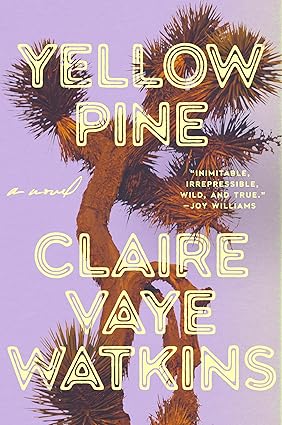
Yellow Pine, the latest novel from Claire Vaye Watkins, takes place toward the end of the pandemic, and Watkins takes her turn with the metaphor of the desert tortoise. In her writing about these prehistoric animals, native to the Mojave and Sonoran deserts, but frequently displaced by residential and industrial development, Watkins asks: Who belongs in the desert? To whom does the desert belong? And what do we do when the objects of our love resist possession because they, or we, are impermanent?
Our heroine, Rose, lives in a cinder-block cabin called Nothingness Flats in Tecopa, California, forty miles from her hometown of Pahrump, Nevada. She works remotely and dispiritedly, fundraising for her local chapter of the Sierra Club. Rose is pushing forty, mother to a daughter named Juniper who lives in Philadelphia with Rose’s ex-husband, “an earthquake-safe doorjamb of a man.” Rose considers her end of their custody bargain courageous. Conceding to her ex the coveted position of school-year parent, Rose sees Juniper only on breaks. Moving to Philadelphia to be close to her daughter is an option on which Rose doesn’t dwell. We sense that Rose has something in common with the desert tortoise, who spends its fifty- to eighty-year lifespan “in one small, intimately memorized patch of desert,” and rarely survives relocation.
Rose has sworn off “sending emails, bickering, buying useless shit, getting run by the algorithm, living in the past.” Rose has a lot of time on her hands. At the invitation of her sunburned neighbor Pastor Jack, Rose becomes a regular at Yellow Pine, a protest camp adjacent to an eponymous industrial solar project on public land in the Mojave. (The project is real: it was accelerated by the Trump administration in 2020.) The construction of Yellow Pine destroyed thousands of yuccas and Joshua trees and evicted hundreds of desert tortoises from their intimately memorized desert patch. Yellow Pine’s electricity will support “data centers, for a so-called cloud that was in fact metals and minerals, water and emissions. All so the earth’s affluent could find every email they’d ever written.” Although Camp Yellow Pine identifies as “not a blockade” and “more of a vigil,” its campers will articulate their demands if asked. All they want is for solar to be distributed within the already-developed environment (panels on city parking lots, for example) rather than on public land. They reject the “false choice between transitioning off fossil fuels and protecting biodiversity.”
At Yellow Pine, Rose meets Fran, “an ecofeminist Whitmanic poetess of equine bearing on hiatus from her PHD at UNLV,” and Ira, “a cute, glum, nicotine-dependent Irish-Jewish Marxist botanist,” and a bunch of other “artists, scientists, wonks, cranks, and hermits.” Rose goes to Yellow Pine to be among a certain kind of person, and to have a certain kind of conversation. Together, these desert rats sing, bitch, and talk shit about their elected officials. They decry the greed and misguided faith of those who settled the American West, those who believed it was God’s will for man to master and possess nature. Spooning sour cream into bags of Fritos and sharing mesquite flour cookies, camp members opine, by the novel’s own admission, “undergraduately.” They break Rose’s no-bickering vow, and their bickering blurs the line between humble activists and the “self-righteous harpies” at Rose’s office job, before everyone went remote.
Watkins arms her characters with litanies. They are dirtbags who can recite the mountain ranges between Tecopa and Tahoe and, in the next breath, list the threats to those ranges and their valleys: “bombs, mines, housing developments, server farms, so-called fulfillment centers, and industrial solar arrays.” In these conversations, Rose feels at home. To speak with reverence for the desert and to curse its destroyers is a kind of prayer, a demonstration of inexhaustible love. But these same conversations may also alienate Rose from the land that is, after all, still here. For all their exultation in their beautiful surroundings, Rose and her friends also seem to regard the desert as something already lost. They repent. They invoke the end of the world. California on fire. The futureless present.
Who belongs in the desert? Rose, born to an alcoholic mother in a Pahrump double-wide? Fran and Ira, as a reward for their activism? Pastor Jack, who only talks about “the Old West, Warren Buffett, and Jesus?” Perhaps the local postmistress, who hides the stamps that don’t feature George H. W. Bush. Probably not “hot young bozos from Vegas making content.” Maybe not feral horses, descendants of war criminals—but what about the wild burros, who built the railroads? No to Silicon Valley tech bros. No to Airbnb slumlords. Yes to the coyotes. Yes to the ungreedy creosote. Yes to the desert tortoise.
There is one person in Rose’s life who hesitates to play keeper of the Wild West. Miles, who got away, is back. Twenty years ago, at state college in Reno, Rose was an undergrad as Miles finished a master’s in linguistics. The pair had a steamy, transformative love affair that ended in betrayal and marriage to other people. Now, Miles is divorced and lives in a van. He collects rocks from the sand and licks them “to see their true color.” He went to Reed and reads self-help. Free-soloing (!) El Capitan didn’t bring him closer to God, so he quit doing it. Rose tells Miles she loves him, and Miles is glad to hear it. When he moves into Nothingness Flats, he agrees to Rose’s anti-scrolling screed (a rule Rose breaks constantly, giving her visiting daughter “unlimited screen time” so she can handwrite a letter to Miles with instructions for driving to Tecopa sans GPS). Miles’s role in the novel is to reveal to Rose, and to the reader, what Rose actually wants. She wants love, and the West, and to feel herself beloved in the West. She wants to soak naked in a hot spring with a view, with her love. She wants to go hiking with Miles. To fuck Miles in her cabin. To occasionally hike and fuck without fretting over climate change. Oh, and she also wants to have Miles’s baby.
Both Rose and the novel are determined to defend Rose against anti-natalists. Rose openly resents population control as a solution to climate change—“renouncing children delights fossil fuel executives”—and agrees when a friend diagnoses liberals with “internalized despotism.” The average reader may need less convincing on this front than Watkins assumes, or maybe I run in an especially pro-natalist crowd (my children). The real blockade to Rose’s fertility is Miles. In a transcendently boneheaded move, he blames his fear of procreation on the ephemerality of his semen, telling Rose, “You’ve had these eggs in you your whole life. Your mom made them when you were in her. I don’t have anything like that in me. I haven’t even made the sperm that would be our baby yet.” A less optimistic woman might send Miles to sleep in the van, but Rose wears her-colored glasses. She looks upon Miles as she does the desert: she can fix him! Rose admits her failure to see Miles clearly, but what Yellow Pine supposes is that maybe the lover is right about her beloved. If a tourist drives out of Vegas into the brown desert and sees only nothingness—dirt and dehydration, decaying brothels and nuclear test sites—is he correct about what he sees? Or is Rose’s reverence for her valley truer? She loves what is beautiful, and what she cannot save. You see where this is going. When Miles leaves, it’s not the end of the world. It’s worse.
Desert roses are resilient, and Rose does her best to set Miles free. She loves him, can’t have him. Can’t she still have a baby? Enacting a scheme she calls The Swirl, Rose consults a lawyer and draws up a waiver. Before a man has procreative sex with her, the man must sign away his parental rights. Rose resolves to mate with every sex god the desert coughs up, and at first she scores big with Bilal, a gorgeous prehistorian visiting Tecopa from Claremont. Bilal’s verbosity rivals Rose’s rants and raves. But his seed doesn’t plant, and the desert is less rich in certain minerals than Rose imagined. Remember, she’s forty. Vanishing are those mom-made eggs. Back at the ranch, one of Camp Yellow Pine’s own (the one who brought the mesquite flour cookies) turns out to have been a plainclothes cop. The community disbands, having failed to save the tortoises, but having borne witness to ruin. A few protesters move into Nothingness Flats and, in a surprising erotic twist, become personally involved in Rose’s new cause.
Miles crawls back home to find Rose increasing her chances of conception by sleeping with all their friends. He’s freaked, and jealous, and his jealousy clarifies his own priorities. Sort of. The reader doesn’t trust him to stay, but we’re not supposed to trust Miles. Instead, we trust Rose to find peace in the space between what she has and what she wants; what she can control and what she can’t; what she will rescue and what will die before her eyes.
Yellow Pine is less emotionally raw than Watkins’s previous book, the autofictional I Love You but I’ve Chosen Darkness (2021), and less plot-driven than her 2015 dystopian debut novel, Gold Fame Citrus.At times, Yellow Pine doesn’t read much like a novel at all. Like Edward Abbey in his trailer in Arches National Park, Watkins has written an environmentalist’s jeremiad on behalf of the disappearing desert. And like Mary Austin of Owens Valley, Watkins charts the history of her northern Mojave, where the Old Spanish Trail crosses the border between Nevada and California. On display is the author’s encyclopedic knowledge of the country’s springs, peaks, and canyons. This novel is dense with dates and lore. Watkins names the territories conquered in the invention of Nevada; describes the bureaucratic process by which the driest state was christened with the Spanish word for snowy; lists the mountains marred by industrial experiments, the bombs and chemicals that have poisoned residents. These facts assert themselves as the history of a region that has shaped your American identity whether you know it or not. As much as Walden Pond. As much as the Mississippi River. Unlike Thoreau’s wilderness, which, in the present day sits a few miles off I-95, Watkins’s West remains wild. There’s no cell service in these foothills. The map you preemptively downloaded to your phone will abandon you at the end of an unmarked washboard road. In the desert you can walk for miles and not see another person. At night, you can still see the stars. (And maybe a pink smear of light pollution, if you look toward Vegas.) For now, there are still coyotes, kit foxes, badgers, jackrabbits, rattlesnakes, and our critically endangered desert tortoise. For how much longer?
Yellow Pine is more than a call to action. You may walk away from Watkins’s novel angry at the Trump administration’s acceleration of industrial solar on public land. Wouldn’t we rather have sacrificed the equivalent acreage in Vegas parking lots? But the novel assigns more urgency to philosophical questions about how to live a good life amid corporate greed, wholesale abuse of the environment, and spiritual defeat. How do we reconcile ourselves to this particular notch on the belt of modernity, the completion of the conquest of the West, when this notch is a wound, and when it’s all we get? I did not personally strip the desert of its flora and fauna, nor did Rose, nor did Claire Vaye Watkins, and nor—unless you are a Silicon Valley energy executive who reads Bookforum—did you. Is it OK to love what cannot be fixed? To be grateful for the stars we can still see? All Rose wants, ultimately, is “to love on this land while she still could—a hospice sort of love.”
I will admit that I loved this novel most when Watkins set aside her exhausting, if justified, litanies long enough to show her characters at their most vulnerable. Details comparing Miles’s comfortable childhood to Rose’s tumultuous past are precise and devasting. Miles, the child of ethical lawyers, comes from Portland, Oregon, where he attended a Montessori named after Mount Hood. Meanwhile, Rose’s single mother temporarily lost custody of baby Rose after a drug raid on the trailer. Rose grew up poor to the point of hunger, lifeguarding at the Pahrump pool by day, and by night pocketing pepperoni from the fridge at her food service job. Another heartbreaking scene from the novel’s final act: passing Yellow Pine in her car, Rose nearly runs over one of the evicted tortoises. The tortoise, of course, is clawing its way across boiling pavement toward the construction site that used to be its home. The metaphor is not subtle and doesn’t need to be. Rose is tempted to take the majestic creature home with her, but he is not hers to possess. The tortoise belongs to the desert.
Finally, consider a flashback, a scene between nine-year-old Rose and her mother, Alice. Rose is irritated when her mother interrupts her in the bath, but, with sudden maturity, resists lashing out. Rose sits in the water, prepubescent and naked, while Alice reads aloud a cherished passage of Moby–Dick. “Rose grasped for the first time—an ephemeral epiphany—the discipline of love.”
By camping along the perimeter of a solar plant, Rose and her friends claim, like tortoises, a patch of desert ground. If their activism is a bit on the nose, especially because it doesn’t work, that’s the point: the futility is meaningful. Watkins suggests that if children are not to blame for the destruction of the natural world, neither are women like Rose who continue to practice the discipline of love. That discipline may be all we have against the threat of our own extinction. During the novel’s brief, welcome dive into the consciousness of Rose’s daughter, Juniper reflects on her mom’s “special voice for talking about the mountains.” Juniper hates this voice, but won’t she grow up to speak in it? The voice is what we inherit, and what we leave behind. The voice of the desert lives in Watkins’s work. She leaves us yearning for the land itself.
Emily Adrian is the author of the novel Seduction Theory (Little, Brown, 2025).