


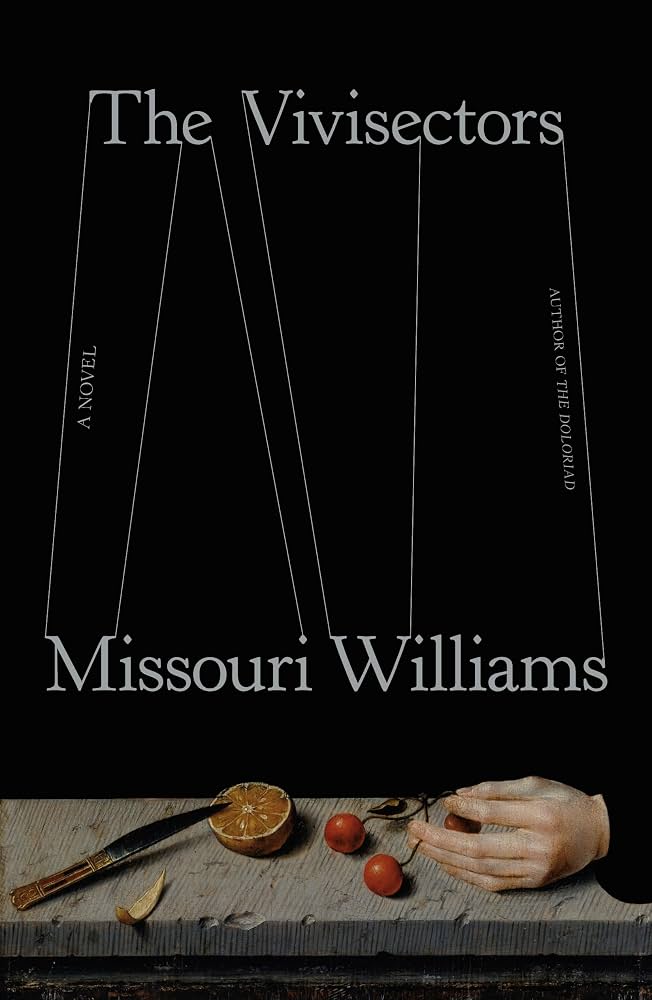
Late in The Vivisectors, the aloof protagonist, Agathe, theorizes about the state of the contemporary novel. “There are no places and barely any proper names,” she reflects ruefully. Agathe is the daughter of a renowned literary critic, who has his own theory on the state of modern fiction, that fiction must now “move as smoothly as possible; there could be no friction. Names, places, culture, and history must be removed in the name of soft edges, in order to smooth the reader along.” This is the kind of book we hold in our hands: a novel about an old-school university in flux that is all soft edges.
Agathe works as an assistant to a professor. Her boss is obsessed with Adam, a handsome young student who frequently finds himself the subject of controversy. He picks haughty intellectual fights in class over the “scandals of syllabi.” He seduces women only to discard them once they’re in his thrall. His most recent debacle begins the book: a professor named Jacob tells Adam to stop peddling conspiracy theories about world domination in class. The two spar over such “an inappropriate remark.” For Adam, the word “conspiracy” is loaded because he is a member of a “persecuted people” who are stereotypically accused of secretly running the world. He tells Jacob that he doesn’t know how Jacob’s people did things wherever he was from, but that wasn’t an acceptable thing to say. Jacob, the narrator tells us, was descended “from foreigners and you could see it from looking at him.” His people had once been slaves, and for him the way Adam talks to him is equally offensive. This is all the more confusing because the book doesn’t use what Agathe would call “proper names” to delineate the groups that Adam and Jacob belong to.
Readers must fill in the gaps, a tricky proposition that reflects whatever biases they might bring to the novel. Williams hints that Adam could be Jewish and Jacob might be Black—she writes, “it had only been in the last fifty years that they had attained something like equality.” The two enter a heated detente, both wanting to oust the other from the university. This is a world of hierarchies, where words like “them,” “us,” “conspiracy,” or “heritage” have a history of conflict behind them. No one can escape language’s ability to shape reality. But while the characters in Missouri Williams’s novel have lost faith in language’s capacity to convey the truth, they still embrace its capacity to confer power.
In her first book, The Doloriad, the apocalypse is literal—it’s a story of an incestuous cult living in a run-down city. Amid the ruins, mutant kids play out a generational struggle for control. The Vivisectors features a decrepit site of higher learning, as a vast garden overruns an old-world college, threatening to swallow up the world of recondite books and knowledge. Williams’s characters fear that tradition is slipping away. They want to hold on to “the essential task of a university, which was that of explanation.” But arcane knowledge doesn’t pay the rent. As trees and shrubs eclipse the quad, restless gardeners hold court and air their grievances in the shadows of ostentatious wealth. Agathe becomes privy to class warfare only through listening to their stories.
The novel sets us up to believe we’re going to experience a battle over “woke” politics—although Williams would never use such vulgar terminology. This is the one way that Williams’s “soft edges” work against her. Terms like “woke” or “cancel culture” are vague; The Vivisectors makes these ideas even fuzzier. Is this a backlash novel? A university satire? Williams gestures at both through Agathe’s boss, who bemoans the younger generation as “vivisectors,” tearing masculine men down, policing acceptable language, and foreclosing important debates in favor of politically correct terminology. The youth “analyzed a situation until we had proved the presence of evil, and nothing could escape our scalpels.”
Williams’s refusal to precisely identify her characters’ subject positions seems like an attempt to strip specificity from contemporary debates—to let readers see past the scroll of discourse to the strangeness of language itself. She avoids tired debates about “wokeness” while still riffing on themes of grievance, injustice, aging, and power—abstracting these issues and refusing to address their concrete material realities. When this tactic touches on race and disability, Williams’s enigmatic approach starts to wear thin. Thankfully, it’s not the only theme The Vivisectors takes up.
WHAT BEGINS AS A NOVEL ostensibly about “cancel culture” quickly shifts into a rueful elegy for a dying world. The war on language is more metaphysical than just the policing of proper social justice terminology, Williams argues. In her universe, those who know when to speak—and when to stay quiet—are rewarded with safety from the horrors. Agathe, for her part, claims not to have a personality. She enjoys working as an editor because “Editing is so vacant that it’s almost holy. You’re not supposed to bring any of yourself to the text in front of you; instead, you are meant to be the conduit for a great and impersonal ideal.” She claims that “there was no longer anything I wished to convey to another person.” Yet she writes. Agathe attempts to explain to Adam her traumatic family life and her dim view of institutions, even if she has lost “faith in words to convey any kind of meaning.” This meta-exploration of what makes a good novel is a probing look into dark academia. Her protagonist walks the hallowed halls of the institution, alone and jaded by its enormity.
The inability of Williams’s characters to communicate with one another has long been a pivotal theme in her work. Her boss, obsessed with Adam, asks Agathe to become friends with him. Like Ivan and Selin in The Idiot, Agathe and Adam orbit one another, their flirtations an on-again, off-again string of philosophical discussions and evasion. “We never spoke about the city or the university. . . . He was a smiling surface, a mirror of my tastes and actions.” They talk about philosophy and literature, John Donne and aqueducts. Their courtship ends up providing the latter half of the novel’s narrative fulcrum. Agathe is haunted by the empty words of those around her: her mother’s failure to confront a traumatic past, her boss’s petty fretting over academic infighting, and later Adam’s inability to be honest about his true feelings for her. Agathe makes the ultimate mistake of getting close to Adam and losing her cool. “I must have looked weak,” she thinks after holding Adam’s hand. Eventually, she ghosts him. Hoarding knowledge is a burden, but it can also be a weapon. Revealing the truth can be just as violent: when the two reconnect, they sleep together, and Agathe tells him that even though she’d developed real feelings for him, she’d gotten close to him on orders from her boss.
The Vivisectors shares a fair amount of DNA with The Doloriad, which features a shifty character also named Agathe and a schoolmaster obsessed with arcane knowledge. Williams has always been fascinated by theology, textbooks, and philosophers. Her prose occasionally sounds like a series of biblical commandments. When Agathe’s boss gives long monologues, Williams eschews quotation marks, forcing the reader to wonder who is imparting judgment. Suffering and sudden violence are detailed in a droll monotone. For example, the novel begins with Agathe detailing her mother’s recent failed suicide attempt. At the end of the novel, Agathe carries her mentally ill mother to a pond in a wheelbarrow. “The metal wheelbarrow was already taking in water and my mother’s skirts were sodden. It was hard and then it was easy . . . I didn’t look back.” We’re left with this image, contemplating whether Agathe has actually killed her mother. Her inability to confront her traumatic family history fuels her inability to connect with her boss, Adam, or really anyone at all. Her friends and parents drift by as dreamy figments.
WILLIAMS’S LANGUAGE IS MUDDY, overflowing, and fertile at once. People are objects, terrified of one another as they wake up to nightmarish scenes. “This is what love is like in my dreams—anticipation of violence,” Williams writes. The light is always “slanted,” casting the novel’s gnomic creations in disquieting atmospherics. Many of the characters are deformed in some way, though Williams does not adopt the language of disability to describe their particular experiences. Some are described as “lumps.”
Agathe’s boss is blunt about her views on disability. She argues that autistic people are on “a superior spiritual level” and she doesn’t “say that about every disabled person because for the most part disability is a punishment for the things that a person did in their previous life.” In her exploration of autism, as with race, Williams lets us see the folly of her characters—their refusal to acknowledge difference without resorting to offensive platitudes. She’s also trolling us. Some works of horror or fantasy riff on disability or gender to flip the fulcrum of power—Williams did so in The Doloriad, a novel in which deformed humans have a fully developed interiority—but that is not the case here.
Throughout her fiction, Williams has been most interested in the malleability of language, reveling in its instability. The Vivisectors is about the ability of words to both create and destroy, and Williams is adept at writing about academia and cancel culture without moralizing. In this way, her new novel runs parallel to films like After the Hunt that attempt to understand the depths of our political divide. Unlike Luca Guadagnino’s 2025 film, however, The Vivisectors refuses to sentimentalize the conflict. Williams’s characters are eventually forced to contend with the carnage of their actions, the way their values—or lack thereof—shape them. In this eerie exploration of jargon and estrangement, Williams has crafted a beguiling dissection of morality.
Grace Byron is a writer from the Midwest based in Queens. Her writing has appeared in The New Yorker, New York magazine, The Nation, Vogue, and other publications. Her debut novel, Herculine (Simon & Schuster/Saga), was published in October.