


SOMEWHERE IN THE MIDDLE of Crime and Punishment, Raskolnikov, Dostoyevsky’s antihero, gives himself one of many pep talks about why he might have been right to have murdered an elderly woman. There are naturally two types of man, he tells himself: the inferior, who can only reproduce what already is, and he who has the ability to bring forth something new. If the latter kind of man, Raskolnikov reasons, “is forced for the sake of his ideas to step over a corpse or wade through blood,” he can surely find in his conscience a sanction for stepping over corpses or wading through blood.
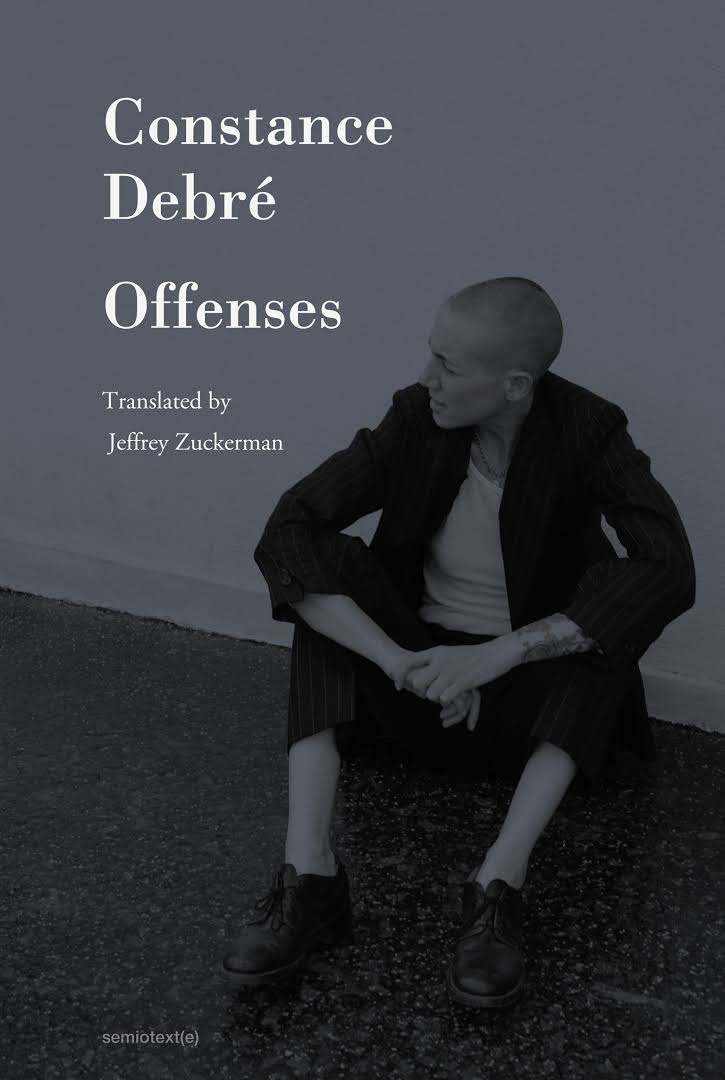
Toward the end of Constance Debré’s autofictional trilogy of novels comprising Playboy, Love Me Tender, and Name, the French writer and former criminal defense lawyer presents us with a similar logic and language: “The hero’s life is full of corpses,” she declares. “Not everyone is up to it. My sister isn’t. That’s why she got married and has three kids and a dog. Most people aren’t. I am.”
That trilogydetailed Debré’s abandonment of heterosexuality and marriage, her estrangement from her child after a grim custody case, her exit from the legal profession, and her attempt to disavow the trappings of an aristocratic upbringing. Between completing these books and writing Offenses, her latest novel to be published in English, Debré maintained her shaved head and minimalist lifestyle, but did not, to public knowledge, produce any literal corpses. For her Dostoyevskian novel she needs a new protagonist. Offenses concerns a working-class man from the banlieue of Paris, who, as in Crime and Punishment, has stabbed an old woman and robbed her. He wants to pay off his debt to a dealer, leave town with his girlfriend and son. Instead, he waits to be caught, which doesn’t take long. He goes to court; we hear the particulars of his case.
While Raskolnikov constructs himself as a hero, comparing his transgression of law to the lawmaking bloodshed of Napoleon and Solon, Crime and Punishment builds to Raskolnikov’s buckling under the weight of his own bad faith. At the time of writing, Dostoyevsky had been sobered by his own run-in with the law, a sham execution, and four years of hard Siberian labor, and wanted to repent of his own utilitarian justifications for violence. In his diaries, he reflected on the folly of once having thought himself a martyr for his preparedness to kill. “The possibility of considering oneself . . . an honourable person while committing obvious and undeniable villainy—that is our whole affliction today!” he wrote in 1873.
The narrator of Offenses has no such realization. The “perp,” as the killer is called throughout the book, is often compared to Christ. The perp is pure in his defiance of expectations, the one, we are told, who has rejected the world’s lies, and will “receive all the punishment as a baptism.” Rather than losing its nerve as Raskolnikov does, Offenses holds tight to this thought. Toward the end of its ninety-one pages, we hear that the perp is “guilty, yes, but he is guilty in our stead. Because someone has to bear the cross. Because someone has to bear the burden.” The killer affirms, “I am guilty, yes, but I am guilty in your stead. Because someone has to bear the cross, because someone has to bear the burden.” This is only the most literal instance of the idea’s repetition, unexamined, until the book ends.
There is a kind of reparative impulse at play here. What vexes Debré is not the delusional minds of murderers, but the delusions of those who presume to judge them. The prosecutor, for example, dressed for the job in what the narrator calls, derisively, his “medieval costume.” Here is a man who, for all his education, cannot fathom a more meaningful context for the murder than the 450 stolen euros he deems a “paltry motive.” Unlike the perp, who was raised in a world of foster care and drug-related violence, this man has been to lycée, passed an exam, and every month since been paid a salary. The problem, Debré writes, is the “judges . . . specially chosen not to know what injustice is.” The point is elegantly put, as is Debré’s observation that men like the perp serve an important social function as scapegoats, excuses for maintaining an order that immiserates the poor. “I killed her to let you judge us,” says the perp, “because this is the way of the world in need of endless victims.”
If these are the mechanics of a world that is ordered by hierarchy, exploitation, and a superficial rhetoric of morals, Debré is less interested than, say, Dostoyevsky in any alternative mechanics. Debré would simply like to see the wretched get their flowers, the hierarchy rhetorically inverted. From the bulletproof dock, the perp muses that judges ought to be judging him at ground level in tracksuits like his own. He imagines himself on high in their regalia as he is punished: “The state should do its punishing on its knees.”
If it sounds like I am conflating the narrator and Debré, the perp and Debré, the novel and Debré, I am. I have my reasons. When interviewed recently about Offenses, three years after writing it in French, Debré affirmed it was a novel she still “agrees with.” This might sound like an odd way to talk about fiction, which typically sits in a more complex relation to truth claims, yet Offenses all but demands to be read as a statement of opinion.
This is not immediately obvious from literary technique. The narration darts without warning, sometimes mid-paragraph, between a third-person voice, the killer himself, and on one occasion his brother. This might have been a novelistic way to test the distinctions and continuities between the perspectives of various parties affected by murder. Distinctions between narrators, however, are limited more or less to the pronouns used to mark them. In their tone, their narrative style, and their idées fixes, the assorted voices that constitute Offenses seem almost identical to those of the Constance Debré who narrates the Playboy trilogy.

The ugliness of things is a major theme in all of Debré’s work: lawmakers and aristocrats, the everyday act of eating. Reflecting in Playboy on when her bourgeois life began to go wrong, Debré proposes that it might have been the third mouth to feed. It stopped working, she says, “Because of the food, I think. Going to the store on Saturdays to fill the fridge up with all that crap. All that time wasted preparing something that would only end up as shit.” In Offenses, the perp comes to us first with a disquisition on the ugliness of the world. He would call the world atrocious, in fact, were it not all so insignificant. “The old lady’s body wasn’t a pretty sight either,” he notes. “Maybe it’s food, maybe it’s all the ugliness around that ends up getting into our bodies.”
The “insignificance,” too, of other people’s lives is paradigmatic Debré. In Name, Debré wonders why violence happens so rarely among the poor given their “awful, pointless lives.” In Offenses, the old woman is “heavy with her whole worthless life.”
So I hope you won’t mind if I continue to write about Offenses as though it were a statement of belief. And at its core is a belief in the value of acts of self-purification. In Love Me Tender, Debré lists the clothes she has kept after quitting her job as a lawyer, moving out of her marital home and getting rid of almost all her belongings: the two pairs of jeans, three T-shirts, old leather jacket, and Rolex “just for a laugh.” For Debré, this is an act of clarity, an act of freedom. “You have to escape,” she insists. “From wherever, however. Escape.” Vilified in divorce court, she sees the attack as an affirmation of her transgressive status. Here it is herself she compares to Jesus, like Socrates before him and Oscar Wilde after––“No great life is complete without a trial,” she says. And in Offenses, she repeats that it is only in “total defiance” and its punishment––that baptism––that purity is achieved.
Offenses makes clear that the cost of this purity is rather high for the working class, just as the scope for legal “escape” is rather narrow. If escaping your life means selling your clothes but keeping your Rolex and your highly tradable name, there’s absolutely none of that here. The best anyone manages in the world of the perp is the brother who has escaped the family home by getting a job stacking supermarket shelves between midnight and four. But the violence and the punishment of “purity,” if you’re poor, seem to Debré to be the best expression of truth in an intractably evil world. “There needs to be some act of violence,” she writes, “or else nothing makes sense anymore.”
Debré has not historically been interested in making sense of the world. In Name, she tells us directly that what interests her is “existence itself, not the conditions of existence.” If she writes entire books about her upper-class past, it is only in the effort to shed it, to live in the present where all that she is is writing in Starbucks, going swimming, sitting around, reading books, fucking women, and walking nowhere. Offenses doesn’t drop the writerly interest in what critics tend to call the texture of life. The perp smokes, plays video games, goes to bed, gets up, feeds his daughter, changes her diaper. But here, texture does more than evoke a life for the reader’s entertainment; it shows us the conditions of a murder. Unlike Debré’s sparse existence—which she chose for herself in adulthood—the perp’s stretches back into a childhood of mere and unpleasant survival, under the tyranny of dealers and of a mother who herself has been tyrannized by dealers, among various other kinds of tyrants.
As for making sense of poverty, of social injustice itself, Offenses very quickly dismisses any such effort. There are some lines toward the middle about capitalism, which the narrator––who at this point is supposed to be the perp––aptly describes as offloading risk, from drug dealer to nanny, from boss to worker, from coke-sniffing lawyer (destined at worst for rehab) to the hash-dealing youth (destined at best for prison). But rather than an ideological system––one whose history has been shaped by the interests, passions, intellectual maneuvers, investments, and revolts both of its victims and its beneficiaries—Debré’s chorus of univocal narrators sees only a black box. In this sense, they are no more insightful than a lawyer is asked to be. “A working system is impossible to dismantle,” Debré writes. “Men cannot do anything about it.” Everything “has been decreed long in advance . . . what’s to be done about that, nothing.”
Debré seems to take this as grounds for rejecting sociological language, choosing instead to describe the world through a series of cosmic, religious, and mythological tropes. In place of the system’s “losers,” we get the “damned,” who are also the “saints.” Their sins become the sins of “all humanity.” Because, as the narrator tells us, the protocol for imprisonment is “chosen not by any single person, but by multiple people, a totality of things for which no single person is responsible,” the conclusion drawn is that no one is responsible: that this is simply “the order of things,” that the world’s vertical geography works a little like Dante’s circles of hell.
Rather than viewing this kind of discourse as a lack of curiosity concerning either the social order or the history of political change, critics have long admired Debré’s “directness” about how fucked everything is, how ugly everyone is, except Debré. Every blurb on the back of my copy of Offenses is in praise of the author’s style and not one mentions what is being styled—themes, ideas. Her “voice is Camusian, relentless”; her “voice is in full command”; this is “one of the most compulsive voices [the reviewer has] read in years.” This makes sense if you can admire a voice without worrying too much about what that voice is saying; admire a meaningless sentence, as long as it gets to its meaninglessness directly. A sentence like “I am preserving the sanity of the world with my life,” or “A junkie is an incredibly moral person.”
And to be fair, statements like these had a certain kind of charm in the lower-stakes autofictional trilogy. I would go so far as to say I delighted in those books and would still very much recommend them. There you could plausibly understand the narrator’s exasperated glibness as the point. There was a person, as vulnerable as any, driven to adolescent ranting by the scourge of bourgeois morals, a vindictive ex-husband, grief for a son, sheer boredom. There was a person amusing and imaginative enough to call a piece of cheese stupid, to call a coffin stupid, to speak of “the sluttishness of books.” We would be justified in paying no attention to the narrator’s claim, in Name, that she was writing “to explain what’s happening and how we should live.” This Debré was very clearly not in the business of analysis or explanation; her business was the business of sounding off.
I use the word “business” intentionally. Debré’s gift has never been changing the reader’s mind, or how they live, but in trolling them for their own titillation, which usually sells. An instructive passage can be found in the middle of Playboy, where the narrator recalls a certain memory from high school. She and her fellow students had produced some graffiti asserting that their teacher was a whore:
The beauty was in the gratuitousness, the absurdity. It had nothing to do with the teacher, no one gave a shit about her. When she cried we all felt ashamed. Not of ourselves. Of her. We wanted to be caught in the act, we wanted her to yell, we wanted her to get even, to give us bad grades. We wanted her to tell us she wasn’t a whore instead of crying. She left after fall break, we never saw her again, we found other games to play.
A good forty years on, Debré has at least perfected this game of calling people names for the right reaction. Addressing the bourgeois reader, the perp declaims: “I’m telling you what you don’t want to see in yourselves.” He lists, for example, our flab, our fear, our falsity, our foulness. Without belief in the possibility of change, the call is not for sacrifice or effort, but simply for us readers to acknowledge how filthy we already are. That our lives are no worthier than the perp’s or his mum’s––that all our bigger apartments have the same crumbling walls, our perfumed skin the same rot. That spending all one’s wealth on oneself isn’t even a sin, just a sickness. You can see the appeal for readers who are used to being told they should do something about the world’s problems. The pleasure of reading Debré has the quality of kink—a series of heavy spanks you can forget all about the second it is over.
But the truth is, of course, that a bigger apartment is still a bigger apartment. A life of spiritual compromise is still somewhat easier to enjoy than a life in and out of actual prison. No amount of bourgeois-baiting rhetoric is going to settle the score and, probably, no divine judgment. That would take political commitment.
Buried in Offenses is an important truth about the state’s distribution of “crime.” A murder is a specific kind of crime, which can only be investigated after it has actually happened. It is a crime with a victim who must pay with their life, even if someone else considers it “worthless.” But there are indeed crimes decreed long in advance, in service of the existing social order, preserving in the process its hierarchies of class, race, ability, sexuality, and gender. I am talking about the criminalization of nonprescription drugs, which yield no profit for the state; of weapons found in impoverished neighborhoods; of vehicles whose owners cannot afford their maintenance needs but can’t conduct their multiple jobs without them. Decisions are made well in advance of any actual action to stop and search the “right” kinds of people, with a view to incarcerating the “wrong” ones. Without, in other words, the need for anyone to wade through blood.
If Debré was keen to demonstrate the persecution of poverty, why not write about this more directly? Why not write about the life-ruining punishment of broken headlights or unpayable debt from piled-up parking fines? Why choose murder, other than for the case’s superficial resemblance to a story once told by a Russian master? At the end of Playboy, we find a clue. Here Debré describes receiving a phone call from “some guy,” when she is still a working lawyer. The guy’s brother had killed an old woman. Reading now, we can assume he is the man we will come to meet in Offenses. Why did the Debré of Playboy take the case? She needed to keep hold of her Rolex. “Either way their lives are fucked,” she says. “Shake down the poor to make them cough up their cash.”
Amber Husain is the author of Tell Me How You Eat, Meat Love, and Replace Me. Her essays have been published in Granta, The New York Times, The Baffler, and more.