


TWO YEARS into writing The New Biographical Dictionary of Film, David Thomson realized that he had veered off course. The book, Thomson’s second after Movie Man (1967), was commissioned in 1971 as a simple encyclopedia on modern cinema. By 1973 he had written close to 500,000 words on cinema’s central figures—actors, directors, and producers. His editors saw it as a “kind of monster.” But it is carried by a style that, by his own admission, is “Personal, Opinionated, and Obsessive.” Readers expecting a typical reference book will be surprised by the strident career assessments and critical judgments. For Thomson, John Ford, director of over 140 films, including She Wore a Yellow Ribbon (1949) and The Man Who Shot Liberty Valance (1962), is the auteur of inebriates, whose elegant cinematic style requires “the flush of drink in the viewer before it is sufficiently lulling to disguise the lack of intellectual integrity.” The deep-focus photography of The Long Voyage Home (1940)or the painterly framing of Stagecoach (1939) cloud their scenes with beauty, a constitutive sentimentalism that reveres the vistas of Monument Valley but obscures a clear-eyed reckoning with American history.“No one has done so much to invalidate the Western as a form,” Thomson writes. Disagreement with these readings is expected, perhaps encouraged. Thomson delights in making a sharp argument and then turning to examine the consequences of that point of view. In the Biographical Dictionary,opinion is not thrown down as the last word but offered as the first premise within a logic of expansiveness: arguments that spiral out from a singular observation to reveal the spirit of a person, the style of a film, a shift in the medium of cinema. Thomson’s entry on Roberto Rossellini cites the director’s desire to see with “a depth which perhaps only the cinema can provide.” Thomson’s best writing works with a similar aim: pulling his subjects into focus like a wide-angle lens, revealing, in new shape and detail, the cinema screen and the world.
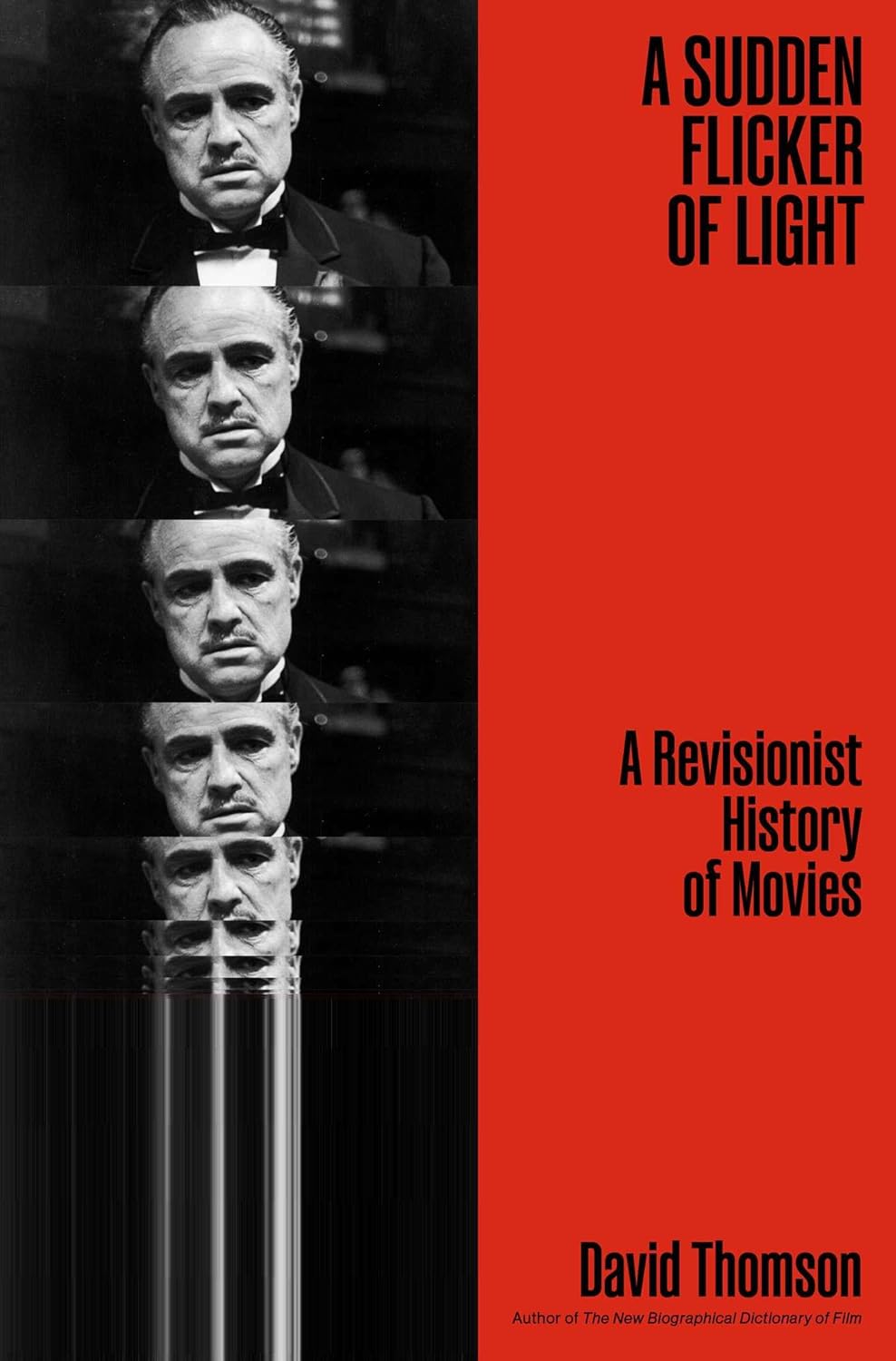
We encounter a very different Thomson in his latest book, A Sudden Flicker of Light: A Revisionist History of Movies,in which he eschews his earlier expansiveness. Here his sharp argument does not point outward so much as suggest the futility of moving forward. This is his intention: considering the shattered media of the present day, he doubts that there is any point to criticism. Surveying the history of the moving image—from the long arc of the Lumière brothers’ early cinematographic machines to the hyper-screened presidency of Donald Trump—Thomson suggests that the on-screen approximation of the real has warped our understanding of the world. The results have been disastrous: violence, misogyny, and voyeurism; spectators strung out on dull fantasies and happy endings. Today, Hollywood is in crisis. The spread of generative AI, the rise of streaming platforms, and the shuttering of movie theaters are the most obvious symptoms. But while the movies have declined, Thomson argues that so too has life “become a movie.” We are so enclosed by screens that we struggle to think beyond them. How might the role of the film critic be re-thought in this environment? Thomson “feels more than regret that over the decades he has given time to wondering which film was the greatest ever made, to distinguishing the auteurs and the artists.” He looks back with remorse on “a career of saying this film, not that one,” turning a rueful eye on his own life’s work. Reassessing the ill effects of movies—cinema’s harmful stereotypes and corrosive myths—as endemic to the moving image medium, he argues for the need to reconsider the moral stakes of criticism. But revisionism from the standpoint of pessimism risks nihilism. Thomson is in danger of denying, not least in himself, the very possibility of a critical spectator.
He didn’t always feel this way. In a 2017 interview in The White Review,Thomson described his early critical approach as indebted to the pioneer critic-directors of the French film journal Cahiers du Cinéma, founded in 1951, which celebrated auteurs including Howard Hawks, Orson Welles, and Nicholas Ray—artists who articulated a personal vision through writing with images. Cinema, for the journal’s jeunes turcs, among them Jean-Luc Godard, Claude Chabrol, and François Truffaut, was an art, and among its greatest artists were the unsung journeymen directors of the Hollywood studio system. Cahiers asserted the importance of cinematic authorship in all-out terms. In 1955 Truffaut wrote, “You can refute Hawks in the name of Ray, but to anyone who would reject them both, I would just say this: stop going to the cinema, don’t watch any more films, for you will never know the meaning of . . . a frame, a shot, an idea, a good film, the cinema.” This animated Thomson’s vision of a medium made glorious by sharpening itself against the grinding pressures of studios, censors, and the market. For Thomson, Hawks was the master of subverting cinematic genre. Thus, Only Angels Have Wings (1939)is an unsentimental melodrama, while Bringing Up Baby (1938) is a screwball that dances on the edge of madness. But within whatever convention he chose to upend, Hawks’s focus remained the same: he wanted to look at how groups—most often men—formed tight-knit communities forged through total bonds of loyalty. “Like Monet forever painting lilies, . . . Hawks made only one artwork. It is the principle of that movie that men are more expressive rolling a cigarette than saving the world.”
The force of cinematic form is what once drove Thomson’s criticism forward. The films of Samuel Fuller are marked out by the movement of the camera; visually the films are “like scenarios made from communities of rats, the camera itself a king rat, scarred and hurt, but still swooping in and out of every scuffle.” Fuller was a director who worked at a frantic pace with tiny budgets and yet perfected some of the most difficult moving-camera shots in cinema. Erich von Stroheim was spurred to greatness, but always almost to ruin, by his persistent dual concern for “epic perspectives” and “a fever for detail.” Actors, too, are authors. Peter Lorre looked “every lunatic part in the eye and transformed them into portraits of delicate, deranged kindness pushed to the point of frantic malice.”
Admittedly,whenopinion gets the better of obsession,this expansiveness can falter, narrowed by the rush to reveal the limitations of a film or the shortcomings of a career. There are only adjectives to refute in Thomson’s review of John Cassavetes’s Opening Night (1977)as “pretentious, then confused, and finally lost.” There is a too-satisfied symmetry in the statement that Judy Garland “left deep impressions on many viewers, but ruinous ones in herself.” The half-sentence review of Jacques Tati’s Playtime (1967)—“a study of the excesses of modern tourism”—may be deadpan, but it’s still deadening. Then again, Thomson can write with a romanticcast of mind that exceeds the usual bounds of cinema and biography. Chris Marker is both a traveler from the past and a “promise of a world to come.” Sterling Hayden, star of The Asphalt Jungle (1950) and Johnny Guitar (1954), is as “calm as a Melville sailor who had seen great sights and was puzzled by the need to talk of them.”
THOMSON WAS BORN in London in the year of Citizen Kane (1941). Growing up in the suburbs of south London when “people went to the pictures in the way they did to the bakers,” he wrote film reviews for his mother to practice critical thinking for an undergraduate degree at the University of Oxford, though he turned down his place there to attend the London School of Film Technique in 1960. In 1975, he moved to America to teach film studies at a liberal arts college in New Hampshire and later at Dartmouth College. When he screened Howard Hawks’s Red River (1948) for his students, he was, he recalls, “like Charles Foster Kane at the opera—I stood up alone to applaud.” The first Biographical Dictionary was published in 1975 and grew steadily in prominence. In 1980, the film director Michael Powell visited Thomson at Dartmouth and suggested that it was time to quit teaching and write more books. He has now published more than thirty, on Ingrid Bergman and Warner Bros., but also on Laurence Sterne and the 1911 race to the South Pole. In his fifty-five-year career he has written widely in the UK and America, including for The Guardian, Harper’s,and the London Review of Books. Settled in America, he encountered more of the subjects of his writing, befriending Peter Bogdanovich and Bob Rafelson. He visited the vast landscapes of the films he loved. He found he hated John Ford’s movies more than ever.
But successive editions of the Biographical Dictionary (there have now been six) testify to Thomson’s growing disillusionment: the grand passions of an auteurist sensibility ground down by the tectonic shifts in modern media’s development. The first volume was written in the early 1970s, the years of Robert Altman’s McCabe & Mrs. Miller (1971) and Terrence Malick’s Badlands (1973), both slanting critiques of an American psyche that sought to resolve the horror of Vietnam in the smoothed-over spectacle ofNixon’s presidency. But if, in the 1970s, cinema was a “medium that bristled with talent and opportunity,” the decades that followed inspired “wistful thoughts of lost grandeur.” The stars of Thomson’s beloved Golden Age were waning. Did the passing of Ingmar Bergman and Michelangelo Antonioni in 2007 herald the end of art-house cinema as a form? As a teenager, Thomson had watched films at the Granadain south London, a cinema of mirrored corridors and deep carpets, built like an Italian palazzo.As a young critic, he had holed himself up in the National Film Theatre and in the city’s repertory cinemas.But in the’90s,he began to watch more films on the television, the picturedegraded by the smaller screen. By the early 2000s, video and the internet had created what Thomson calls an “infinite openness,” and a distracted way of watching to match. His concerns for the medium were not simply technological but existential. For the digital age revealed a fundamental truth about all cinema, that “the project of looking at film always failed to grasp how much we were caught up in the process of looking at screens,” splitting the spectator from the true reality of the world through a false approximation of it. It still comes as some surprise, however, when he declares in the introduction to the fifth edition, “I love books more than films.”
THE TITLE OF Thomson’s A Flickering Light is taken from a novel, Henry James’s The Portrait of a Lady (1881). For Thomson, James’s metaphor seems to predict the cinematic apparatus, pointing toward a glorious future for the medium in which the capacity to capture and project images of the world would reinvigorate perception. “Great God, if that was 1881, how did civilization find the patience to wait so long to have movie invented?” And Thomson describes, with loving detail, the scenes of excitement that accompanied the birth of the mass medium.Thousands gathered in 1896 at Koster & Bial’s Music Hall in New York, enchanted by the sight of a sea that was rushing in but could not wet their feet. As they watched each other watching, they became conscious of a new way of seeing. But as cinema matured, this reflexivity diminished. And while the medium developed technologically, compared to literature there were capacities that it still lacked. For Thomson, the physical placement of text on a page in a book enables “a chance to reflect, re-read, or imagine.” The white space that surrounds black type offers a literal and metaphorical location for the crucial work of critical thinking. In contrast with the “adolescent, narrow-minded intensity of film,” the layout of a novel encourages a vital mode of questioning that the locomotive of screen images rushing past may stifle. The linear narrative of a film—or at least the narrative art house and Hollywood cinema that Thomson analyzes—leaves no place for the “largeness of imagination.”
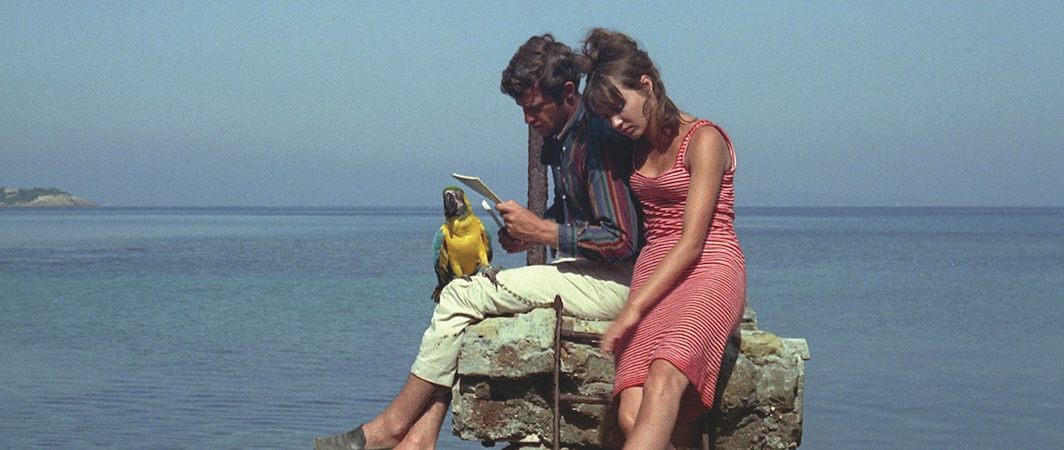
How, Thomson wonders, can filmmakers transport the “white space” of the page to the screen? This “white space” is there, he writes, in the camera’s ability to capture the fleeting first glance that unites Anna Karina and Jean-Paul Belmondo in Pierrot le Fou (1965), and it winds through the film, creating narrative shocks that disturb easy spectatorial assumptions.It is there too in the minimal movement of the Yasujirō Ozu’s camera, a restraint that encourages active watching. It is also present in the looseness of Robert Altman’s Raymond Chandler adaptation The Long Goodbye (1973) in a scene that Thomson describes. Marlowe, played by Elliott Gould,
has a cat addicted to curry-flavored food; it turns up its nose at salmon or licorice. And Altman takes his time over it. When Marlowe goes to the store, meets a clerk filling the shelves, and asks for curry-flavored cat food, the guy scoffs and says all those damn foods are the same, and tells Marlowe to get a girl instead of a cat.
As Thomson argues, Marlowe’s concern over the correct flavor of cat food doesn’t fit with Chandler’s books. Surprise at its inclusion reverberates back to memories of more faithful adaptations; to Bogart, so poised and aloof, in The Big Sleep (1946). One image, then, can comment on another. A reflexive form of filmmaking that stands in open and ironic judgment of its own development.
But what beyond its pleasures might the canon reveal about the history of cinema? In 1905, Thomas Dixon published The Clansman, the second of three novels set during the American Civil War and Reconstruction, white-supremacist epics written in response to Harriet Beecher Stowe’s Uncle Tom’s Cabin (1852). His books sold in the millions. The Clansman toured as a successful theater production. But Dixon saw that the new medium of cinema could draw bigger audiences and enlisted D. W. Griffith to transpose his vision to the silver screen. The Birth of a Nation (1915), the most expensive film made in America at the time, built Hollywood; its huge profits were invested into the first film studio in Culver City, Los Angeles, headed by Louis B. Mayer, the future head of production at Metro-Goldwyn-Mayer. It also changed cinema. When Griffith replaced the flat on-screen space of early silent films with a new system of close-ups and cross-cutting—continuity montage—it looked a lot like life.
What Thomson calls the “first fascist film” was foundational. Surveying the history that has followed, he makes a ledger of artistic gains weighed down by moral failing. “Nothing was lovelier or more surprising” than the coming of sound in the late 1920s, but, Thomson argues, the great screwballs of the 1930s gave little voice to the suffering of the Great Depression. As Josef von Sternberg built the myth of Marlene Dietrich, so the cinema framed Hitler. (Was it Chaplin that skewered Hitler, or “had Adolf tried to look like Charlie?”) Alfred Hitchcock’s films are masterpieces of control, but the violence of Psycho (1960) “unleashed a pretty damage”—stylization that distanced audiences from the real effects of force. Morality, not artistry, then, is the more pressing criterion for judgment. But moral analysis can shade into ethical reductionism, imparting too much causative power to the moving image as a destructive force in the world while reading individual films too narrowly as proof of good or evil deeds. Watching Hitchcock’s Rear Window (1954),Thomson imagines a more palatable plotline in which James Stewart turns away from the crime that he has glimpsed through his telephoto lens across the courtyard, sitting down instead to enjoy a happy breakfast with Grace Kelly. “That leaves no movie,” Thomson realizes. It leaves no criticism, either, a see-no-evil logic that stops the film and its analysis in its tracks. Safer, perhaps, to look away.
In the Biographical Dictionary, Thomson valued authorship as a way to undercut industry conventions, and A Sudden Flicker of Light stillcelebrates filmmakers who resist commercial imperatives through an openness of form and style. Thomson compares the mechanized perfectionism of Frank Capra’s studio cinema with Jean Renoir’s open-air receptiveness to disorder, attuned not only to “human nature and the ways we interact but social nature and the larger context, nature itself.” He delights in the stretched warp of historical time in the films of Terrence Malick, which suggest that it could still be “in the nature of the medium to be less tidy and more incoherent.” But these moments of critical openness—of Thomson’s continued curiosity toward the nuance of cinematic form—are increasingly outweighed by his pessimistic view of the overarching evolution of the medium. While Thomson wants “to believe in a mainstream of cinema” the book builds toward his feeling of a “drab sense of powerlessness,” a vanishing hope that artistic sensibility can overcome the problems of the moving-image form, the horror of Hollywood’s origins, and the unethical effects of the media’s development.
Both the medium and its message can corrupt, he hammers home. When the sheering noise of the El train screams to a crescendo during Michael Corleone’s first kill in Francis Ford Coppola’s The Godfather (1972), Thomson urges his reader to “Think how many murderers on-screen are effectively exonerated by us.” Is Corleone “a monster or a bleak model?” Thomson asks, perhaps the most uninteresting question one could ask about the development of this character. There is a lovely tracking shot in Goodfellas (1990), but has Martin Scorsese “yielded to the sheer pleasure of making up yards of stuff about bad guys”?Andif we delight when bad men prosper, what of the lie that they get their just deserts? Jacques Tourneur’s Out of the Past (1947) is a noir of sharp dialogue and “liquid grace,” but should it have done more to expose the ways in which the powerful escape punishment? Time and again, Thomson sounds the alarm. But this line of criticism feels one-note, the riveting complexities of these films flattened by his desire to extract what he sees as their degraded moral core.
As the bad news builds,Thomson stays light on his feet, springing back and forth through time, a fragmented structure to mirror the experience of short-form video in the attention economy. While this breaks up the history he is working to convey, the reader is rarely in doubt about the end point of the narrative. Donald Trump is a “movie man” who admires Kane and Corleone. The filibuster of Frank Capra’s Mr. Smith Goes to Washington (1939) is twinned with the daylong Senate speech of Cory Booker in 2025. Thegrimcurdling of aspiration in George Stevens’s 1951 A Place in the Sun reveals an America wanting “to be great again.” Loosened from the weight of narrative history, these films are positioned in a Trumpianteleology, corralling historical and cinematic time into a cul-de-sac of political inevitability.
But this book is a revisionist history of “movies.” Thomson expands the usual phrase “the movies” to include all categories of the moving image, a neologismtoreflect how cinema’s dominance has wanedas smaller screens have multiplied. Films are made for streaming services, Thomson argues. We watch cinema on TV. For Thomson, moreover, a Golden Age of television, beginning in the late ’90s, made shows like The Sopranos (1999–2007), Breaking Bad (2008–2013), and Babylon Berlin (2017–25) the “big movies of the last thirty years,” gigantic films that “built as if purpose and narrative were still possible.”
Television has long been central to Thomson’s thought and writing. Before he left Dartmouth in 1981, he introduced television studies there, suggesting to the faculty that the medium mattered more to his students than the threat of nuclear war. In the 1940s and ’50s, TV was notable by its novelty. For some time after, as Thomson argued in Esquire magazine in 1997, TV was even a character in the movies, anoverdrawn antagonist, “an eternal, surreal fire of libido, psychic violence, and derangement in that supposed haven—our home.” Now that television has become ubiquitous, we notice it less, but Thomson has found inventive ways to alert us to its presence.In the later editions of the Biographical Dictionary, he discerns the always “on” glow of television in the eyes of George Clooney, an ambient charm distinct from the cinematic alertness that had animated Cary Grant.
But when Thomson amalgamates the media as “movie,” he retreats from the possibility of a film language that can interrogate the spectacle of modern media, and the book’s conceptual architecture begins to buckle. Film and television become movie. Critical thinking and the art of cinematic authorship become the white space of the page. “Are you still watching?” he asks at one point, addressing the reader of his book. But it’s unclear what to see, or even how, as Thomson’s vision of the crisis collapses into a nebulousness that shocks of moral seriousness cannot reconfigure.
In this confusion, cinema’s oppositional potential is harder to distinguish. Sergei Eisenstein described his 1927 film Strike as “a revolutionary victory not merely for the work itself but also as an ideological victory in the field of form.” Thomson turns to the film’s most famous scene, the suppression of a 1903 factory strike that intercuts images of slaughter in an abattoir with the massacre of striking workers. Through rapid-fire juxtaposition, Eisenstein links animal and human death, in a dual condemnation of commoditization and class exploitation. For Thomson, while the film is “overwhelmingly lovely,” he is reluctant to relate Strike’s formal ingenuitywith Eisenstein’s political commitments: “I don’t think Eisenstein cared a damn about the workers; he reveled in the lyrical turmoil on a screen.” The opening credits of Dziga Vertov’s Man with a Movie Camera (1929) declare, “ATTENTION VIEWERS! This film is an experiment in cinematic communication,” making clear the film’s refusal to be structured by intertitles or a story, so better to demand the active participation of its audience. But while thefreeze-frames, stop-motion, and split screens with which Vertov reorganizes the modern Soviet city, reveal, for Thomson, the camera’s power to capture daily life and a neat set of cinematic tricks, the film is still, ultimately, “an advertisement for itself.” No “white space,” then, in the aftermath of the Bolshevik Revolution.
Thomson pulls politics and cinema apart. Artistry, too, can be overlooked. Reading Virginia Woolf’s 1926 essay “The Cinema,” he cites Woolf’s reflections on early newsreel footage, moving images separated by time and space from her own direct experience: a dangerous detachment, perhaps, between the lived and the perceived. But, sacrificing sustained engagement with her text to the book’s fragmentary form, Thomson skips Woolf’s conclusion, that this fledgling art might “transfix” the speed and sparkof urban life, her inkling of a cinematic modernism.
Revising the history of movies, Thomson overcorrects his own method. When pessimism threatens the expansive logic of his critical voice, he is in danger of obscuring the cinema that still turns critically to the world. For if these media are all the same, there is little sense of cinema opposed to spectacle, of a force that may give critical defeatism pause. In the 2004 edition of the Biographical Dictionary, Thomson added a long entry on the author Graham Greene.
In his written fiction, Graham Greene kept a bleak wariness for what he called “cinemas,” tawdry caves where pictures played. He did not trust their comfort or diversion, any more than he relied on consolation from their neighbors on gray streets, the churches. But in life, Greene ignored his own warnings; he loved to make himself available for the dark and its threats.
Greene wrote screenplays, among them adaptations of his own work, including Brighton Rock (1948) and The Third Man (1949). For a time, he was the film critic for The Spectator, and he appears, briefly, in Truffaut’s Day for Night (1973). Deep into cinema, then, for a skeptic. His writing, too, he argued, was charged by a sense of movement made possible only by cinema:
When I describe a scene . . . I capture it with the moving eye of the cine-camera rather than with the photographer’s eye which leaves it frozen. . . . I work with the camera, following my characters and their movements. So the landscape moves. When I turn my head and look at the harbor my head moves, the houses move, the boats move, don’t they?
Today, Thomson watches two films a day, in and among the shards of moving images from the internet. Like Greene, it is cinema that still animates his best writing. Like Greene, he should resist the inertia of his own warnings.
Georgie Carr is a writer living in London.