


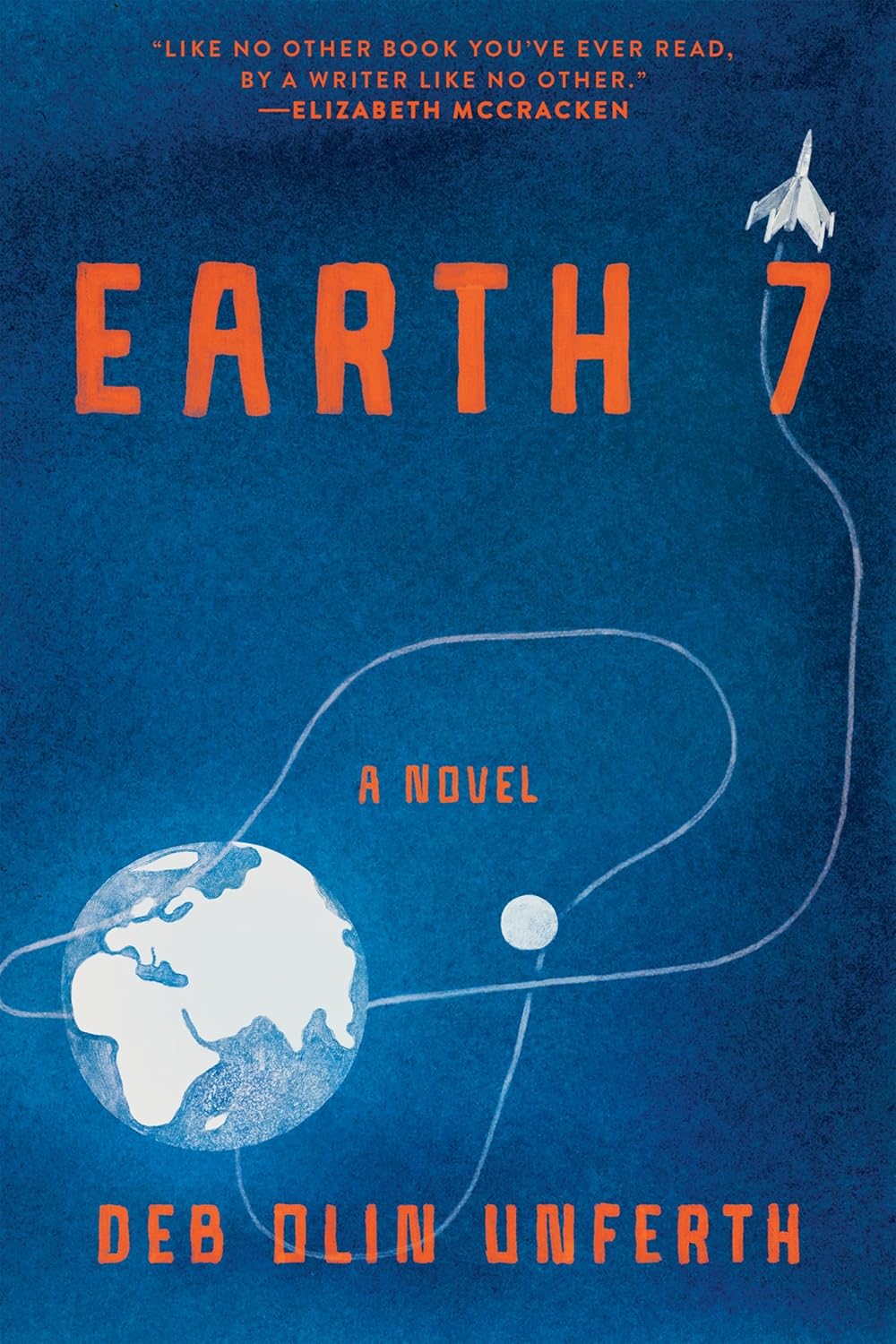
WHEN THE WORLD ENDS, what will you miss most? I’ll miss running in the woods, and the buttery, grassy smell of a horse’s cheek. In Earth 7, Deb Olin Unferth’s third novel, characters miss what they never knew: Earth in her prime. From their perspective, the golden age of Earth includes our own current moment, everything you and I can still experience: mountains, skateboards, dogs, trees, amusement parks, fireflies.
In Earth 7, Unferth introduces Dylan, a child who lives with her mother, Rosemary, in a pod beneath the ocean’s surface. Dylan’s life in the pod is cramped and stultifying. She has one toy, a stuffed snake. Eventually she places the snake in the “grower” that produces the lettuce Dylan and her mother eat. In Dylan’s mind, the snake and the lettuce are friends. Rosemary doesn’t like to talk, and so Dylan listens to the ceaseless churn of the nuclear generator, the glug of the ocean, the rumbling of distant pods. Her childhood passes while she stands by the window, hoping to see fish. The fish, extinct, never come. Dylan and her mother may be the last fish in the sea, trapped in their transparent dome.
Earth 7 is, in part, a mother-daughter story, its themes familiar: the mother’s longing to protect and control the child, the child’s resentment of her mother’s rule. Rosemary herself is an orphan refugee who survived the previous generation’s attempt at “depopulation.” (Unferth spares us the details of genocide; the novel displays a merciful disinterest in the logistics of dystopia.) As a child fleeing death, Rosemary was guided across the ocean by “an alien from another realm,” then adopted by researchers for whom she still works—albeit very remotely. Officially, Rosemary’s job is to record and preserve DNA sequences. Her secret ambition is to separate consciousness from the human body. She longs for awareness, without all the excretions and decay.
Radically antisocial, Rosemary opts not to connect her pod to other pods by underwater corridor. As a result, Dylan has no easy access to their neighbors, nor, later, to the ecotourists exploring the all-but-abandoned Sea Garden. Rosemary trains Dylan to wear headphones and to speak softly, rewarding her daughter’s silence with occasional “talking sessions.” Dylan plots to leave the pod—at first on sanctioned field trips with other pod children, on which they ogle ancient shipwrecks and the sunk corpses of extinct species. During one such outing, Dylan stages an unsuccessful mutiny, demanding the class be taken to shore. Rosemary finds her daughter’s restlessness frustrating. She fantasizes about putting her child “in stasis.”
Dylan hits puberty, and she gets louder, unleashing “a new, ferocious variety of tantrum.” She tells her mother she hates “living in a vat at the bottom of the fucking ocean!” and that “fish are lucky to be extinct.” Rosemary explains that she and Dylan are not at the bottom of the ocean, they’re clinging to a shelf, and that Dylan will inherit the pod when she turns twenty-one. Dylan screams she’d rather die. As she matures, Dylan takes the shape of a classic rebellious heroine, rejecting society’s rules—or the only rule that survives societal collapse, the rule of the mother.
As the novel’s villain, Rosemary is perfect. She’s a techno-optimist, certain that progress relies on scientific advancement. She pines for outer space (much of Earth’s population has, by now, decamped to Mars) and hates her home planet for its noises, lights, and gravity. She resents the “trivial, complex, difficult psychologies” of other people. As she works on her consciousness project, humanity strikes her as a strange theater. She scoffs at people, with their units of measurement, their toys and music and romance, their repulsive bodies, their insistence on giving names to arbitrary collections of cells. Dylan, born nameless, named herself.

ONE OF THE NOVEL’S more intriguing mysteries is Dylan’s origin. Rosemary, however emotionally sterile, managed to have a daughter—a living, breathing, slouching daughter. Dylan doesn’t know whether she has a father. It is almost impossible to imagine flesh-phobic Rosemary having sex. It is easier to imagine Dylan as the result of a maternal science experiment, another data point for her mother’s research. Would a character as misanthropic as Rosemary create life on purpose? Would she, a ward of a dystopian research facility, have been allowed to reproduce? And if Dylan is a clone, from whom was she copied? Earth is running out of DNA. There are only so many possibilities. Rebellion may be a genetic trait.
Only by leaving these questions unanswered—and, for the most part, conspicuously unasked—does the novel elicit them at all. Dylan doesn’t dwell on what might have inspired her mom to make her. As all parents eventually discover, our reproductive motivations do nothing to satisfy the needs of our flesh-and-blood progeny. Rosemary’s neglect of her daughter is not hypothetical; it’s the condition in which Dylan is raised, even as she’s raised in inescapable proximity to her mother. Between these creatures of the deep, tensions are sky high—until Dylan grows up and leaves the pod for an internship. Paradoxically, Dylan’s freedom causes the novel to lose momentum. In the pod, the stakes are obvious: Dylan wants out. Once she’s out, washed up on the shore of what used to be civilization, it’s unclear there’s anything left to want. That a ruined planet may be unworthy of preservation is Unferth’s point, but she makes it at the expense of her story’s urgency.
THE ABSURDITY OF A TEENAGER landing an internship in the aftermath of myriad climate catastrophes, unspeakable genocides, and mass exodus to Mars is part of the novel’s sly humor and charm. Much like the eighteen-year-olds of earlier generations, Dylan discovers that the world for which she has yearned is indifferent to her. She returns to her birthplace, a molecular collections lab in the desert, where researchers maintain vast heaps of DNA with the hope that Earth, or some facsimile of it, might one day be reconstructed. The lab, which continues to employ Dylan’s mother from afar, is a sterile, industrial environment composed of “cubes and rectangles blasted so white, they looked like they had dropped out of the sky.” Grounds are serviced by inept robots, populated by scientists in identical lab coats. Does Dylan miss her horrible mother? (Do you miss yours?)
Having struck out on her own, our heroine falls in love twice: first with sand, then with Melanie. One is the most authentic, natural matter Dylan has ever known. The other is a woman so augmented and modified by plastic surgery and experimental procedures that she’s commonly understood to be a robot.
Initially, Dylan’s relationship to sand is Sisyphean. Unmoved by the lab’s preservation efforts, and turned off by connections to her mother, Dylan reimagines her internship as a janitorial position. She spends her days sweeping sand away from the facility. She pushes against the sand; the sand pushes back. She prefers this practice to pretending to save the planet and imagines that her futile sweeping is “perhaps not so different from most jobs since the beginning of the world.” Gradually, the sand seduces the scientist in Dylan: “When dry, it moved like water. When wet, a solid.” Dylan becomes fascinated by “the motion of sand . . . its great project of sweeping around Earth with the wind and tides. Its endgame, its deep settling at the bottom of the ocean, only to be thrown upward in great planetary disturbances.” Sand is what remains of the dry land Dylan dreamed about—all those mountains on which she never laid eyes. “Especially sand like this, beat up by the wind, dragged up and down Earth’s layers five times since being shaved from its shale rock at the beginning of the world.”
Placed under a microscope, the sand reveals skeletons, entire animals “desiccated and preserved.” Almost by accident, Dylan continues her mother’s research and conceives of a way to store DNA on the backs of dormant micro-animals entombed in the sand, so that whole species might eventually be reborn. Perhaps this storage process is analogous to what Rosemary imagined she would be doing by putting her daughter “in stasis”: keeping Dylan safe, until a distant future, when life would be worth living.
THE DYSTOPIAN NOVEL is a kind of flex for the twenty-first-century writer: How convincing is the specificity of my apocalypse? (And how literary?) At its most tiresome, the genre replaces world-building with world-deconstruction, defaulting to elaborate, itemized descriptions of how it all goes to shit. In Earth 7, annihilation is the setting rather than the action. Catastrophe is the water these characters swim in—or used to.
Unferth is smart to take the world’s demise for granted. The choice allows her to shine as a literary portraitist. Dylan is a fully realized protagonist who carries herself with an adolescent awkwardness, a rank discomfort that, in her sci-fi context, is profoundly humanizing and sort of sweet. She wants to be normal, but she isn’t normal: she was raised in a vat at the bottom of the ocean. Her desperation for other people clashes with her horror of unfamiliar bodies. In her room at the lab, she grows “sick with disgust and desire.” When she masturbates, she thinks of rubbing herself against “sentient AI trapped in metal.” No wonder, then, that she falls in love with a pseudo-robot.
Melanie is a bartender at Vacationland for Singles, a resort where Dylan, at the insistence of her colleagues, celebrates her birthday. The resort is real, in that it has a physical location. It’s fake in all the ways that count: fake ocean, fake trees. A fake blue screen masks the sulfur in the real gray sky. When Dylan ventures past the resort’s digital barrier, she finds herself back in the trash-strewn desert at the end of the world.
Melanie, too, is beautiful and fake. Another depopulation refugee, she was chosen as a child by reality television producers who promised her fame (and survival) in exchange for submitting to experimental cosmetic procedures on camera. Now, decades later, she’s stuffed with plastic and fiberglass, saddled with a face full of microbeads that already have exploded in a third of recipients. Melanie has “permanent alloys, acrylics, nanomaterials—filler implants that were almost as old as she was and that anchored onto disintegrating bone.” To keep her artificial insides intact, she moves with a robot’s “economical right-angle precision.” Melanie hopes to die before the beads in her face explode. “She might get lucky: cellular disintegration. Life, then death.” She fears immortality: long ago, she overheard a surgeon bragging about having isolated the trait for unending consciousness, just before slicing her open. Scientists have altered her body in the most fundamental way, rejiggering her DNA.
Does Dylan love Melanie for Melanie’s irrepressible humanity or for her robotic body and designer DNA, her intelligence that may be as much artificial as natural? Raising the question with Melanie almost costs Dylan the relationship. Melanie has embraced life as a robot. She’s unsure she wants to be recognized as human by humans—in part because they’ve only ever done her dirty, and in part because her body is a ticking time bomb.
When Melanie abandons her job at the semi-fake resort and finds Dylan at the molecular collections lab, she makes no promises to stay. But she also never leaves. The couple grows old together in a built-out storage container, “old” being a wildly subjective term when one person has lived with unmitigated exposure to radiation, contamination, artificial light and air and food, and the other is immortal.
By falling in love, by sharing lives, Unferth’s characters appear to tap a well of hope amid global despair. On the level of the plot, though, the story never totally recovers the momentum it lost when Dylan fled Sea Garden. Gradually, the storage container in which Dylan and Melanie live fills with sand: dry and deep, difficult to move through. As a metaphor, sand often represents time; here it can’t help but evoke the narrative action as well.
DYLAN’S FINAL ACT OF REBELLION is to eschew every imaginable intervention and die at age forty-four. Melanie, herself ageless, buries the novel’s protagonist in the sand. Meanwhile, Dylan’s mother has uploaded her consciousness onto a microchip and launched her digital remains into outer space. Melanie lives long enough to receive, on Dylan’s behalf, long, rambling voicemails from the orbital consciousness of Rosemary, delayed by hundreds of years. In time—vast quantities of time, enough to turn rock into sand and to count the grains—Melanie’s body decomposes, and her “soul globules” sink into the earth and witness the interminable death of the planet we once called home. In time, time itself breaks down as a meaningful, linear metric, and Melanie is revealed as the mysterious alien who once guided Dylan’s mother across the ocean. Isn’t it pretty to think that, when blessed and cursed with eternal, time-warping consciousness, your first order of business would be to prevent your dead lover’s young mother from drowning?
Unferth’s narrative outlasts Dylan by a good fifty pages. Arguably, there’s a conflict between Unferth’s subject—space and time on a cosmic scale, unending—and the form of the novel, which ought to end around the time its tensions break or its protagonist dies. Unferth lingers in the world she’s built, reluctant to let it go, ready as the reader may be to say goodbye. The writer’s attachment to her story suggests sympathy with the generations of human Martians who never set foot on Earth but nonetheless cling to hazy, inherited memories of their homeland. Using a salvaged molecular collection—Dylan’s life’s work, shlepped to Mars and abandoned in a disorganized storage room, untouched for generations—future Martians clone the creatures who once roamed Earth. At least, the creatures who might do all right in space. Bugs, mostly. Cockroaches are resurrected. Grasshoppers leap around the station. These insects are the end result of Dylan’s sand-preserved DNA project, titled Earth 7, like the final draft of an undergraduate’s term paper. Is Earth 7 a shoddy imitation of the real thing? Are we already living on a degenerative iteration of Earth? What would our terrestrial ancestors think of our polluted skies and oceans, our atomized and fractured communities, our declining biodiversity, our devastated literacy and attention? We hope they’d grasp the fall. Then again, maybe only the denizens of a later Earth, like Earth 7, can trace the slide from Earth 1 to Earth 2. The destruction may have to be total before it’s self-evident.
Earth 7, in its speculations about the environment and the cosmos, veers into science fiction. But Unferth goes beyond the tropes and conventions of the genre. She has honed her playful, idiosyncratic prose over a long career as a short story writer. She fully realizes the vulnerability of her semi-immortal characters. Her political and philosophical reflections on the Anthropocene and the entire universe push past the usual limits of the novel, for better or worse. Ultimately, Unferth addresses a genuinely romantic love letter to a dying planet. Of the novel’s characters, only one is granted a bodily death and a final resting place in dust and sand; by no coincidence, she’s our story’s hero. That the narrative itself resists such finality can be read as an offering of hope—or as a warning. The world will end, but don’t expect to be neatly annihilated, nor reconstituted for a post-Earth future. We’ll go on like this. We’re at home in the rubble.
Emily Adrian’s most recent book is the novel Seduction Theory (Little, Brown, 2025).