


IS THIS WHAT IT FELT LIKE, living through 1975, the months before everything came apart? Or fell into place, depending on—relative to the chess pieces, people’s lives—your position. That year, a leftist politician named Maarouf Saad was assassinated in Saida, the northernmost tip of southern Lebanon, while leading protests against a scheme to monopolize the country’s fish trade. Less than two months later, a bus full of Palestinians were slaughtered in Ain el-Remmaneh, in Beirut. After that, gunmen exchanged fire, shells volleyed across neighborhoods, checkpoints dammed up the flow of people east and west—all of this added up until the country found itself engulfed in a civil war. Classically, inanimate objects act; where men do appear we are uncertain who is who. Muslims against Christians, although this is not quite true. Left against right, although this is not very precise. Those for and against the liberation of Palestine, although those experiencing it acutely might not have articulated it like this—not, at least, while they were in it.
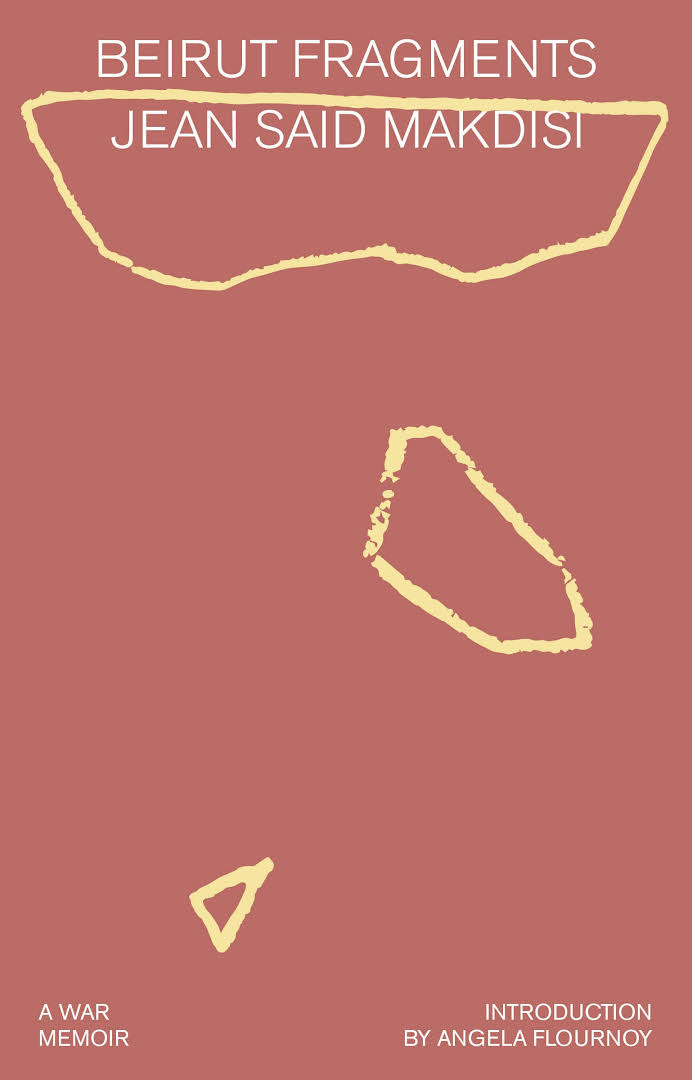
Beirut Fragments, by the Palestinian scholar Jean Said Makdisi, was written as she lived through Lebanon’s civil war, which ended in 1989. The memoir was first published in 1990, less than a year after the Taif Agreement that stopped the fighting was ratified. At the time, Makdisi was in Beirut with her husband and three boys. In the book, she recalls a friend commenting at a dinner party that someone should record “this madness.” She decided to try her hand at keeping some kind of score. She was “relieved” at dinner to find “no political discussion of causes, effects, and apportionment of blame.” Similarly, what follows is a score that doesn’t take a side, not really. “Sides” matter for the historical record. For Makdisi, history means “the tragic smashing of individual lives by its cruel hands and the scattering of bewildered people reeling from its blows.” History is out of the hands of “ordinary people.” Makdisi’s concern is to convey with acuity the feeling of being trapped, as history happens to you.
A writer can relate to sitting down and wondering, initially, what shape the words should take. “How to write,” she asks herself, “what form to choose. I tried to force the experience into a comprehensible shape. . . . Clarity, reason, justice, symmetry, tradition, decorum—those were the tools I brought and they were as easily defeated as if I had tried to contain a pool of blood with a picket fence.”
She trials a diary entry for the reader:
Heard new sounds. . . . Suddenly there is a tremendous crash. . . . Collect children from playground, where I see to my relief Samir has turned up too, and all of us go to underground parking lot. . . . Children all want to go to the bathroom. (If truth be told, so does everyone else.) No bathroom to go to. Create a pissoir in a corner; the little boys enjoy themselves briefly with their rival streams. I catch the eye of MS, who looks at me sheepishly and shrugs his shoulders. Last night, over a drink, he had carefully analyzed the political and military situation and had proved beyond any doubt . . . our area was absolutely safe.
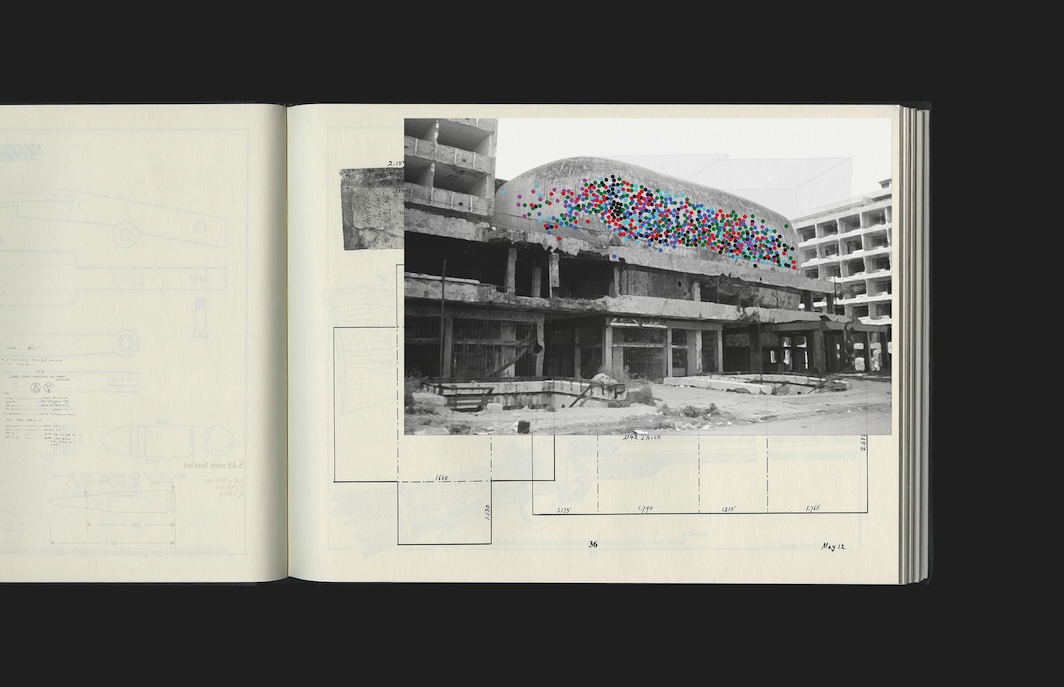
The passage is breathless. But it would have been impossible to write any of it down, she explains, on the day it happened to her. She was too scared, “too shaken, too disoriented.” And, more practically: “I did not have a notebook. It was lost in the rubble somewhere.” She was “too busy calming the children” and navigating the move to her mother’s house. Instead of diary entries, what follows is part memoir, part glossary, part anecdote, part poetry, whatever works to give this particular chaos a container.
At points it is hard to keep track of where we are, temporally—to appreciate how much time has passed. Time is almost suspended, because we are so caught up in the now of fight or flight, or because we are inside our author’s head, mulling a generalized deflation, with sentences like, “Ceasefires come and go; the battles rage on. Nothing is accomplished.” If it often feels like we are moving in circles, accompanying Makdisi and her family to and from the makeshift bomb shelter, debating if life should hold its breath or exhale, taking walks to de-stress, greeting neighbors, eating with friends, wondering whether to stay or to go—and, more often, wondering whether the decision to stay was the right one—oscillating between sharp emotional poles, it is because fifteen years is a long time. In a chapter called “Crisis, with a Glossary of Terms Used in Times of Crisis,” Makdisi compiles the “new language which Beirutis on all sides adapted to life-saving use . . . loaded with profound emotion.” She instructs the reader on how they might have learned to communicate, were they in her shoes. A sampling:
shu fi? What’s going on?
fi shi? Anything wrong?
fi shi Something
ma fi shi Nothing
These phrases together, she writes, “represent a body of experiences” that nonetheless can “only hint at this extraordinary aspect of the war”—how words’ meanings take on new, evolving weight—“and provide a skeletal guide to those who wish to understand.” This “body of experiences” also brings one closer to understanding the experiences of war through the body. Members of my own family survived the war; some have shared over the years what they remember. With her glossary, Makdisi tries to capture something like ubiquity. This road is salika wa amina, she recalls hearing on the radio, informing citizens a path was safe to take. Years ago an uncle of mine recalled this same phrase; he could still hear it, he said, in the broadcaster’s voice.
Two more items from Makdisi’s glossary:
Sihtak bil dinya Your health is worth
everything in the worldTiyyarat Airplanes
This first expression (sahtak bid-dinya is how it sounds to the ear) is spoken when someone has been robbed or lost their home or business to bombing or something else, to reassure the person they still have what matters most—and to help orient them toward gratitude for what’s left, which is often materially little. The phrase tiyyarat, she explains, “invariably” means Israeli airplanes, announced “by a couple of sonic booms followed by the thunder of antiaircraft fire with a rattle of machine guns thrown in for good measure.”
MAKDISI WRITES WITH A PARTICULAR AUDIENCE in mind: “I was educated by Englishmen and Americans, absorbing their culture and values along with those handed down by my own Arab ancestors. I was tossed about in the gales the two worlds blew at each other.” A chapter called “Mirrors, or Contradictions: A Self-Portrait” opens, “I was born in Jerusalem, grew up in Cairo, aged in America, and died in Beirut.” (If this sounds familiar, the reader might note that Makdisi’s maiden name is Said, that she had a brother named Edward.) In “Mirrors, or Contradictions,” she recounts traveling to the United States for college, where she encounters a bit of a culture shock.
One day she is asked to participate in a panel about women’s experiences in our region. She expects to amuse friends with anecdotes about her childhood under Arab patriarchy; instead, she finds herself cornered with questions on Israel and Palestine, about which, at that time, she knew only what she had perceived.
“Why do you hate Jews?” “Why do you want to throw all the Jews into the sea?”. . . They brandished clippings from the New York Times; they quoted, or claimed to quote, from a hundred books and articles by people whose names I had never heard; they twisted statements made by Gamal Abdel Nasser and thrust them, smelly objects now, at my face; they took the history that I had lived and which I knew from the living of it only, turned it upside down and trampled on it.
She had a sense of the immense injustice committed against her people, but only through her family, the sunken faces of those ethnically cleansed from their homes, the way they paced around spaces, waiting, the new permission her mother gave her father to smoke cigarettes—once passed furtively—out in the open.
But she did not know the history. “I had no dates, no names, no maps, no newspaper clippings with which to parry theirs.” So, she went to the library and read and read and read. Finally, she “understood what had happened in Palestine” and could argue her position with confidence. Quickly she realized her own naivete: “I believed that my failure had been mine alone and that, if only I had been better prepared, they would have understood everything.” Who among us, Arabs living in the United States and committed to both Palestine and an earnest belief in the goodness of people, has not had this experience, and the chilling realization that follows: “In spite of the knowledge I acquired of dates and names and places . . . I was no better off in later arguments. This kind of hostility, it seems, is not vulnerable to proof or argument.”
Makdisi understands both the power and the limits of equipping a person with their history. Still, when she writes about us, she writes generally—about “acts of hatred” against which, “as against violence, there is no use in argument, only in flat out rejection, and refusal.” Perhaps this goes back to the people for whom she was writing, who—like that reporter who interviewed the Palestinian author and militant Ghassan Kanafani all those years ago—believe, as children do, that fighting is bad, no matter what. Reading Beirut Fragments, I found myself wanting more, for Makdisi to write instead to me, to take a material side, and to tell us why.
My favorite chapter is the one about the Israeli siege of Beirut. In 1982, Israel invaded Lebanon in an operation called Peace for Galilee, and besieged the western part of the city, where the Palestine Liberation Organization (PLO) was based at the time. Before this, Israel was in and out of southern Lebanon, although like today those farther north felt this presence less—until the siege. In a chapter called “Summer 1982: The Israeli Invasion,” Makdisi tells us where she was when it began: at the edge of a soccer field, waiting for her youngest son, age eleven, to receive an award. Israeli fighter jets streaked the sky with white lines. As they had done by then for years: after bombing somewhere in the south, Israeli pilots might in a terrorizing twofer continue north to break the sound barrier over Beirut. As boys argued over whether the plane overhead was an F-15 or a Phantom or something else, Makdisi observed that this time the air raids seemed different.
It started with an assassination attempt against the Israeli ambassador to London, for which Israel blamed the PLO. Instead of reading it like this, however, as one might in a history book, Makdisi shows us schoolboys speculating about what might explain the attacks while taking cover, noting the news from a few days prior as a possible Zionist pretext. Next, the foreigners were told to leave, and then there would be no school for the boys, and then the power went out, and soon after the Israelis advanced to Saida. The Red Cross asked the Israelis for a truce, and then visitors arrived at her door, and people waited for information, anything at all, about their families in between news broadcasts, when “messages of reassurance [were] sent by individuals” as well as, “more poignant, requests for reassurance from people who had totally lost touch with loved ones.” And then the Israelis reached Beirut.
Where Israel is concerned, Makdisi is more willing to allocate blame. Every day, she listened “angrily to news reports of debates in the United States about whether or not the wide use by Israel of cluster bombs was defensive and therefore legal.” As the bombs continued to fall,
For once I found myself in agreement with rhetoric that had previously irritated me, and the accusatory word genocide no longer seemed exaggerated. There was no doubt in my mind that the Israelis wished to destroy not just an organization or just an army but to stamp something out entirely: principally, the idea of Palestine in the minds of Palestinians and their supporters.
Because hers is an experiential account, Makdisi does not often mention the south, which was then occupied by Israel. Among the few times she does, she and her boys are watching a scene on TV; initially she thinks to turn it off, to shield them, but then she decides she has “no right to censor even war’s ugliest realities” from her children. A plane has crashed and the body of an Israeli pilot is in the hands of the people he had moments prior been trying to kill. “They were beating it, kicking it, cursing, their faces distorted in rage.” The boys watch with a sort of “morbid curiosity.” Once it is over, the mother and her children argue about the response. “What would you do if we had been killed?” her sons ask her. “What if you had lost everything in an air raid?” “‘I hope,’ I said, ‘I hope I wouldn’t do that.’” She will revisit this moment for months. “Who was I sitting comfortably in Beirut, to disapprove their reaction?” Still, despite what she sees, on principle she maintains her stance against violence as such.
She recalls standing there at the start of the Israeli invasion, “mesmerized” by the sight of fighter jets. There was, she writes, “a peculiar relationship between Beirutis and the Israeli planes: If one dared, one might almost call it romantic.” Sentences like these appear sporadically, to perform something like tension, an in-betweenness compelling at the level of the sentence, that “strange commingling of repugnance and desire, alienation and belonging, intimacy and coldness.” It appeals, I think, to the same tastes that might push someone from the diaspora to write about feeling out of place, from neither here nor there. I understand the sentiment. Still, I don’t know anyone who lived in Beirut during the siege—or anytime—who has mixed feelings where Israel is concerned, who met the sounds and signs of the jets there to destroy their lives, with anything like intimacy, with anything less than repugnance. (This may have something to do with where I’m from: missing from my social circles is anyone who would call themselves a “Beiruti,” even after living in the capital for decades. They are jnoobi, from the south—this comes with its own sensibilities.)
MAKDISI WONDERS IF, WHEN THE END OF THE WAR IS REACHED, she will recognize it. An adjacent question: How to know when you are in it? I texted a friend the other day that I feel like I’ve been holding my breath for two years. I wondered when the great war would finally happen. I clicked send and then thought, what if this is it? The reissuing of Beirut Fragments this year coincides with what feels like a long middle, the extended brink of a renewed civil war. How did we get here?
Following the Taif Agreement, a general amnesty law was passed in 1991 that pardoned nearly everyone, and many were eager to shed memories that would not benefit a fragile national coexistence. Today, Lebanese schoolchildren’s history books stop after our French colonizers withdrew, around 1943. There is no Nakba in 1948, no US Marine landing in 1958, no Israeli invasion in 1978 or ’82, no liberation in 2000, no July war in 2006. And there is no account of the civil war, because there is no consensus around blame. The party that carried out the Sabra and Shatila massacre—killing thousands of Palestinians and Shia Lebanese—remains a power in Lebanese politics, supported by the United States and Israel. Where there is no accountability, no consequences, there is no chance for things to change.
If one cannot articulate who did what to whom, and why, something like Beirut Fragments becomes the only way to write about what happened. That its subtitle is simply “A War Memoir” nods at Makdisi’s genuine attempt to represent all Beirutis. In excluding what might alienate some, she risks losing what gives us a sense of commitment. And, in cohering a story’s identity around Beirut, she excludes the country’s south where, especially after the withdrawal of the PLO, the sides and stakes and motives were and remain clear.
Reading Makdisi’s memoir alongside others helps complete the picture. Soha Bechara, who in 1988 attempted to assassinate the leader of a proxy force assisting Israel’s occupation of the south, and was for this imprisoned for the subsequent decade, also wrote a civil war memoir of sorts. In 2003, a few years after her release from the Israeli torture camp Khiam, she published Resistance: My Life for Lebanon. She observes, initially, that “war is madness,” guided by a “skewed and perverted logic.” On this she and Makdisi agree. She sees the “kidnappings on all sides, the checkpoints springing up everywhere, the city split in two as we looked on, stupefied.” Still, as she looks, she keeps in mind that “Lebanon has only one real enemy, one occupying power: the state of Israel. To my mind, the civil war was just a consequence of that situation.” I don’t think she and Makdisi disagree on this point, either. Rather, where Makdisi chooses to dwell on the consequences, for Bechara history happens through as much as to people. And despite Bechara’s own visceral aversion to violence, her country is occupied. As a young Christian woman, she is less suspect; as such, she can be useful in helping to end it.
For Makdisi, “the worst danger of all, in this bloodbath into which we have been plunged, is not the loss of life, but the loss of faith. I don’t mean loss of faith in God: I mean loss of faith in humanity and in each other.” In a country as geo-strategically significant as Lebanon, part of the work of a civil war—or, what is perceived as such—is this: to erode your trust in the people around you, such that you misconstrue your enemy.
Today we still do not know, not definitively, who killed Maarouf Saad in Saida, although people have their suspicions. We do not know who fired the shots at off-duty Phalange members while at church—what prompted the Ain el-Remmaneh massacre as revenge. We do know the assassins’ car bore an obvious PLO logo, which makes it exceedingly unlikely they did it. The question is, who would benefit from cartoonishly framing the PLO? Who is staging framings similar to these, today?
I am reading Beirut Fragments while in Beirut, where besides the occasional hum of drones, things seem to be mostly OK. As people go about their lives, in the south every day paramedics are killed in double- and triple- and quadruple-taps while attempting to rescue people from the rubble of their homes, Israelis detonate whole residential blocks, and the people of the land continue to resist.
Maybe thinking about this moment as a brink is incorrect: we are already fighting a war. I do not know anyone from the south who has not lost someone. Were the violence to extend to parts of Beirut (beyond the Dahiyeh, the suburb to which southerners were in the ’70s and ’80s, as a result of Israeli invasions, displaced), maybe then some would call it a civil war. Still, it would be a continuation of the struggle left unresolved at the end of the last round of fratricide—Zionism, its inherent expansionism, and a country divided over whether to endorse or refuse it.
The sides are clearer today than then. The introduction to the new edition of Beirut Fragments, by the writer Angela Flournoy, moves between civil-war-era Beirut and the current genocide in Gaza. While she is right to draw a temporal line, she skips the bridge: in Lebanon, the path to Palestine is through its south.
Mary Turfah is a writer and resident physician.